
The real pain killer for financial analysts: Kepler on the GameStop-eBay deal
In early May 2026, GameStop made an unsolicited $55 billion bid for eBay. On May 12th, eBay’s board rejected it as “neither credible nor attractive.” Somewhere in those ten days, every covering analyst on the street probably got the same email from their PM: give me a view on this deal by end of day.
If you’re one of them and you don’t already cover the names, you’re starting from a blank page on a deal that’s already moving: a mountain of quantitative data and qualitative claims to work through, a deadline measured in hours, and no room for a single wrong number. We put Kepler through the four workflows that cause analysts the most pain in exactly this situation, and we show each step with real screenshots, so you can see how it takes you from blank page to a defensible view. This is the difference between a supplement and a painkiller: the tools you have now are nice to have, but here are the four places Kepler actually stops the pain.
Here are the four workflows we’ll walk through:
- Get smart on the deal: a cited, verifiable briefing on offer terms, premium math, financing structure, timeline, and where each side stands from trustworthy sources.
- Pull eBay’s financials for the last decade: as-reported, three-statement data pulled straight from SEC filings into a workbook where every figure links back to its source so you have a solid foundation to work with.
- Mine a decade of earnings calls for insights: management’s strategic narrative on marketing spend, active buyers, GMV growth, and take rate, assembled chronologically with every claim hyperlinked to the transcript.
- Map the change-of-control economics: a side-by-side of what each company’s executives stand to gain in a deal, every figure traced to the proxy.
Workflow 1: Get smart on the deal
Summarize the GameStop - eBay deal. Include offer terms, premium math, financing structure, deal timeline, and key statements from both sides.
Before you can do any real analysis, you need to know the basics: what’s being offered, at what price, how it’s being financed, and where each side stands. Most analysts would Google it, or type the question into ChatGPT or Claude, and there’s nothing wrong with that instinct. The problem is what you do with the answer. You can’t put it in front of your PM unless you’re sure every fact is real, not hallucinated, and not pulled from some random corner of the internet.
Kepler runs a broad web search, the same way you’re used to from other AI chat tools, but with a few things that make a real difference for finance work. We don’t pull from random sites just because they show up in the index. We make sure every conclusion we draw is directly linked to underlying evidence through our system, so the hallucination problem that makes other tools unusable for real work doesn’t exist here. And like everything else on Kepler, every fact is cited and traced back to its source, so you never have to wonder whether we got it right.
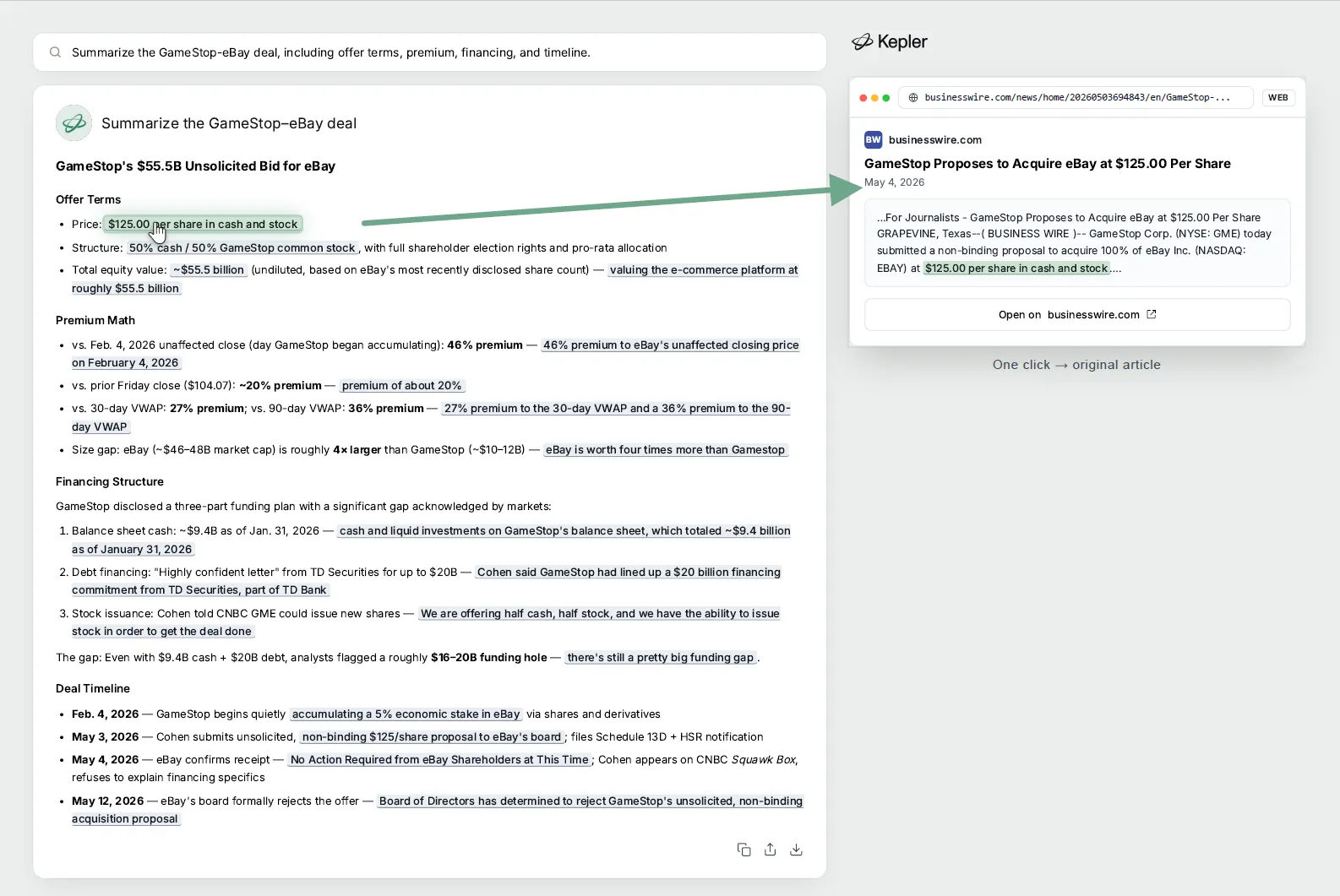
Workflow 1: a cited deal summary, with every claim traceable back to its original source in one click.
Workflow 2: Pull eBay’s financial statements for the last decade
Pull eBay’s financial statements for the last 10 years
This is the foundation of every diligence process, and it’s also one of the most tedious things an analyst does. As-reported three-statement financials pulled directly from SEC filings, formatted into a workbook you can actually build off of. Done manually, it’s the kind of work that can take the better part of a day, especially if you’re being careful about getting the line item hierarchy right and not silently restating anything.
The strange thing is that most analysts still do it manually even though half a dozen data providers will sell you exactly this. CapIQ, FactSet, Bloomberg, all of them have it. The reason analysts ignore those feeds and copy-paste from 10-Ks themselves is simple: it’s the only way they know for sure that the number on their model matches the number the company actually reported. Standardized data feeds restate, reclassify, and occasionally just get things wrong, and when your PM asks why your revenue number is $40 million off from the 10-K, “that’s what FactSet had” is not an answer.
That’s why at Kepler we don’t take the shortcut of buying this data from a vendor. We pull it directly from the SEC. Kepler identifies eBay’s ticker, pulls the 10-Ks from FY2016 through FY2025, and extracts and consolidates every line item across the three statements, all from the original filings.
The output is a clean, downloadable Excel workbook. Click any number and Kepler highlights the exact source in the original filing on the side bar, so you can see at a glance that the figure on your screen matches the figure on the page. No black box, and no guessing whether the model got it right.
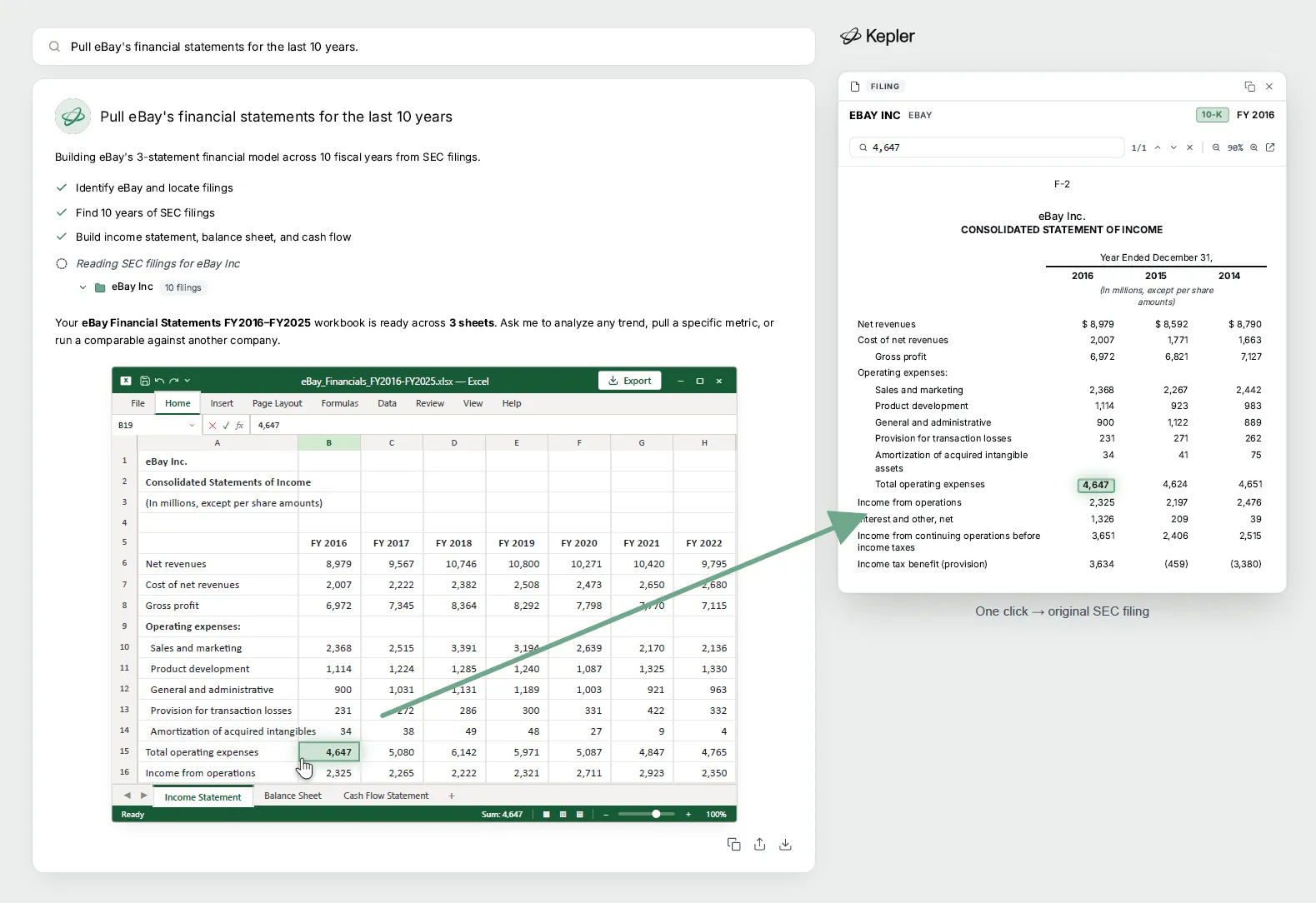
Workflow 2: a clean three-statement workbook for eBay, FY2016 through FY2025, with every cell clickable back to the line in the original 10-K.
Workflow 3: Mine eBay historical earnings call transcripts for the strategic narrative
Mine eBay’s earnings calls from Q1 2018 through the most recent quarter and analyze the following topics: 1. sales and marketing spend, customer acquisition cost, and marketing efficiency 2. active buyer trends 3. focus categories strategy 4. GMV growth and take rate, including segment or geographic breakdowns where discussed
To build a real view on a deal, you have to understand the target’s strategic narrative as told by its own management. What have they said about the business over time? What have they promised? What have they actually delivered? The answer to those questions doesn’t live in one quarter’s earnings call or one investor day. It lives across years of management commentary, and you can’t form a defensible view without going back through all of it.
For eBay, that means roughly 33 quarterly earnings calls of meaningful data. Done by hand, the work is exactly what it sounds like: download every transcript, ctrl-F your way through each one for mentions of marketing spend, active buyers, GMV growth, take rate, and the focus-category strategy, then try to assemble a coherent narrative from thousands of pages of text. It’s the kind of project that usually gets half-finished.
Kepler reads every available transcript in full and organizes the findings into a chronological narrative across the themes you specified. Every specific number, every named program, every claim about what management said is hyperlinked back to the exact passage in the source transcript. Click +120 bps YoY and you land on the actual line from the Q1 2018 call where the exec said it.
This is where Kepler is doing something other LLM tools can’t. The synthesis is real, but the synthesis is grounded in source material that you can verify in one click. When your PM asks “where did they say that?” for any specific number, any claim, any piece of color in the analysis, the answer is one click away.
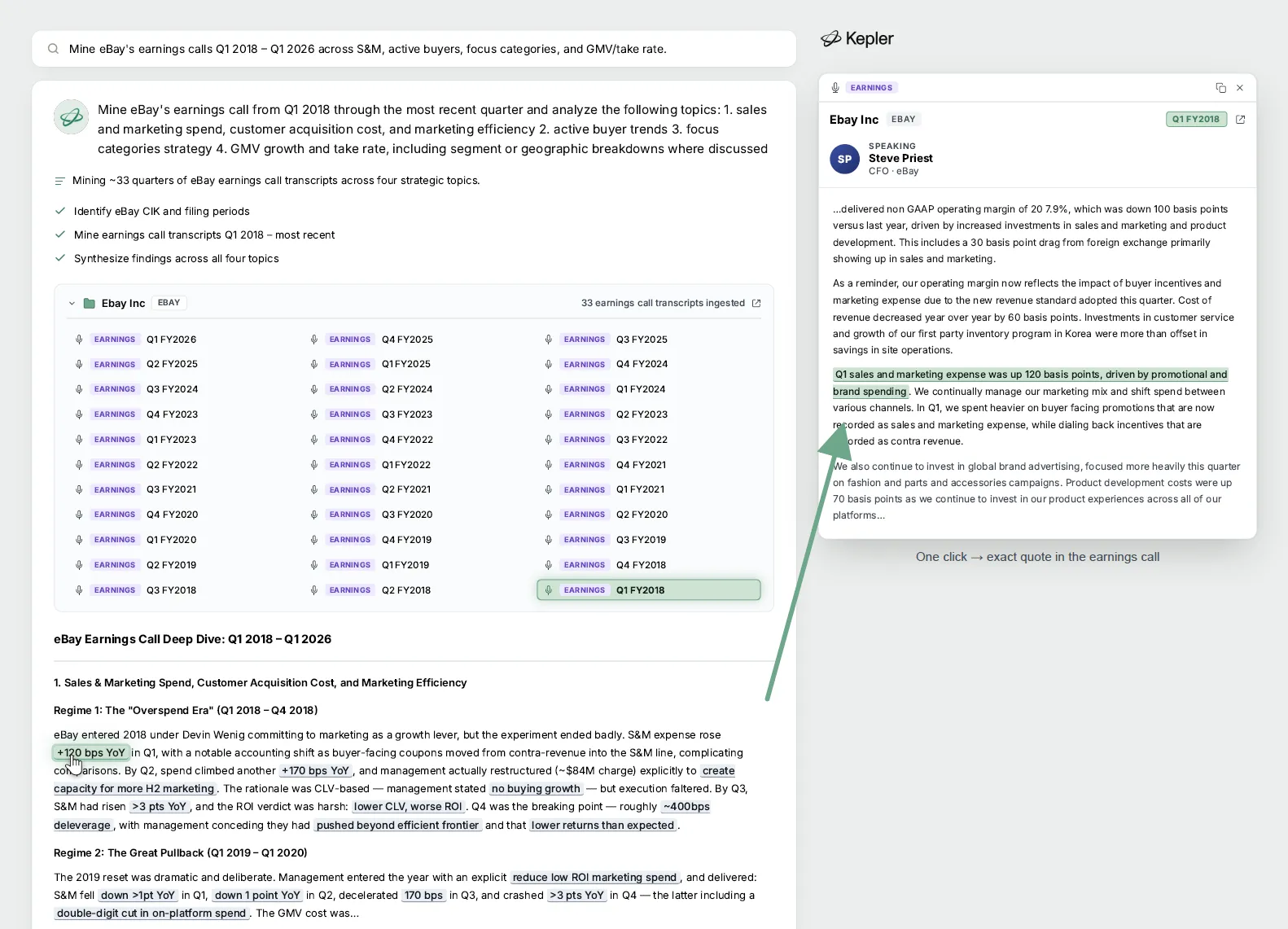
Workflow 3: a chronological narrative across eight years of eBay earnings calls, with every number and quote hyperlinked to the exact line in the source transcript.
Workflow 4: Map the change-of-control economics for eBay’s management
Pull the most recent DEF 14A for eBay and GameStop. For each named executive officer, extract base salary, target bonus, unvested equity, and change-of-control terms (cash severance, equity acceleration, 280G gross-ups).
In any contested or hostile situation, management incentives matter as much as the underlying financials. The single biggest predictor of how a board will respond to an unsolicited offer isn’t the strategic logic of the deal or even the price. It’s what the executives personally stand to gain or lose. Before you take a view on whether a target’s board is likely to engage or fight, you need to know what its executives would receive in a change of control.
That information lives across each company’s most recent DEF 14A and the underlying employment agreements it references. A typical proxy runs eighty to a hundred pages, and the relevant disclosures are scattered across half a dozen sections that don’t always cross-reference each other cleanly. Done by hand, you’d work through the Summary Compensation Table, the Outstanding Equity Awards table, and the “Potential Payments Upon Termination or Change in Control” section, then cross-reference the employment agreements for severance multiples and equity acceleration triggers. It’s the kind of analysis that often gets skipped entirely when the deadline is the close.
Kepler reads both proxies in full and produces a side-by-side view of change-of-control economics for the named executive officers at each company. For the target, it calculates the dollar value of equity acceleration at the offer price using the share counts from the Outstanding Equity Awards table.
With that side-by-side in front of you, you can answer the questions that actually drive board behavior. What does the CEO walk away with at the deal price? How does that compare to what they’d earn over the next three years on a standalone basis? Does the acquirer’s team stand to make significantly more or less than the target’s? You stop guessing at the board’s motivation and start having a real read on it.
Every figure is clickable, traceable back to the proxy footnote or filing it came from. You’re not betting your credibility on the AI, you’re using it to help you with the work and then verifying what matters.
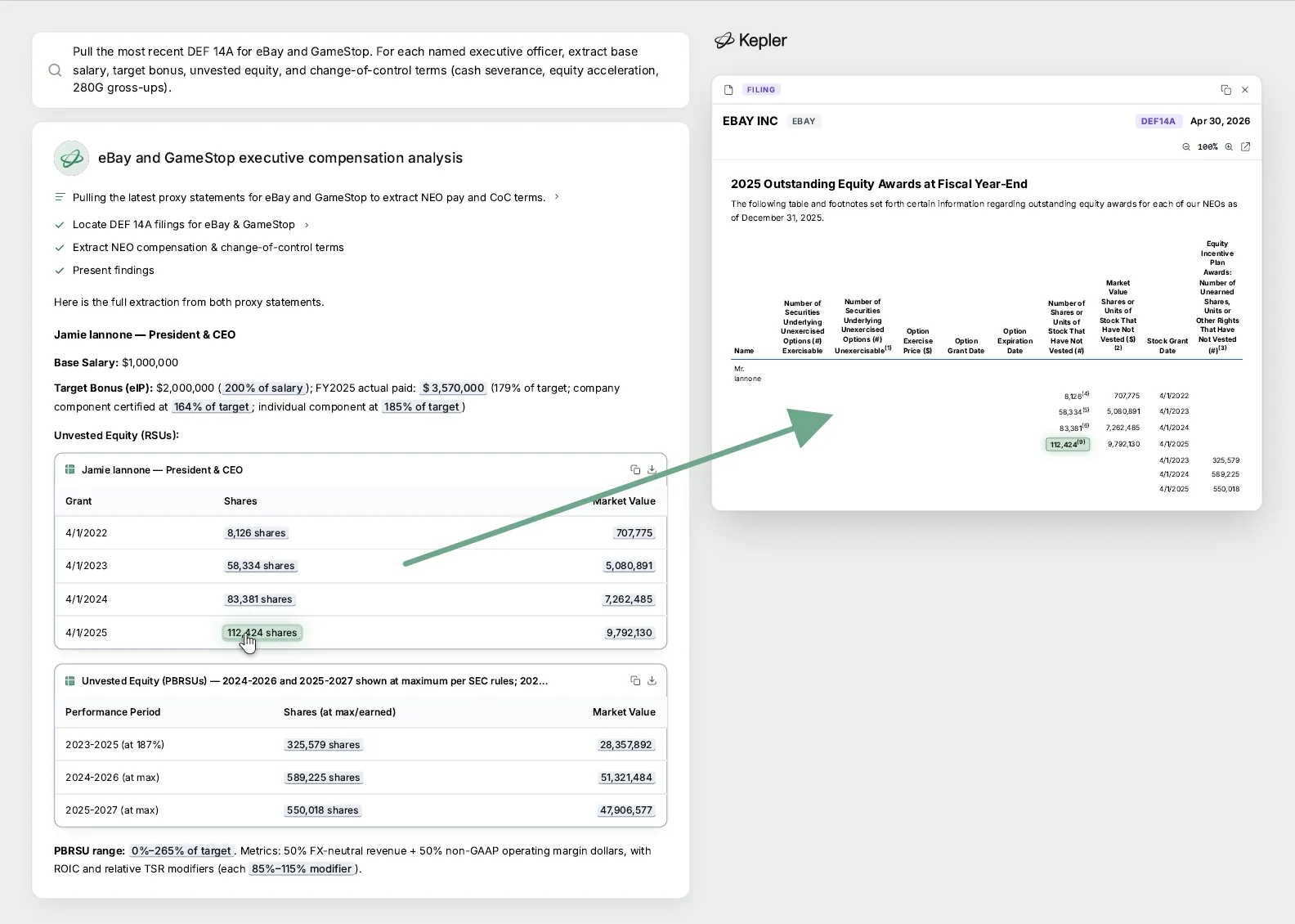
Workflow 4: a side-by-side view of change-of-control economics for eBay and GameStop named executive officers, with every figure traceable back to the proxy footnote it came from.
The point
None of the work above is novel. Every covering analyst at every shop is doing some version of it all the time. What’s different is that today, almost all of it gets done by hand, because no analyst is going to put an unverified AI output in front of their PM and keep their job for long.
That’s the gap Kepler closes, and it’s why Kepler is a painkiller and not another supplement. The tools analysts have today are nice to have; they don’t touch the pain that keeps you at your desk at 4AM. Kepler does, because every number, every quote, and every assumption in these four workflows is checkable in one click. Not probably right. Provably right.
If you have a deal landing on your desk this week, or a name you need to get smart on fast, request a demo.