Anthropic S-1 Breakdown
Anthropic filed its S-1 with the SEC on October 26, 2026, putting real numbers behind the company that makes Claude. The filing shows revenue going from $41M in 2023 to $4.6B in 2025 and $16.3B in the first six months of 2026 alone, an operating profit of $974M in the June quarter (the first in any period the filing reports), and a first-half net loss of $80.7B that comes almost entirely from fair-value charges on financing instruments, mainly convertible notes marked up as the company's valuation rose. Below: our research note on the filing, how we built the model, and the full Excel workbook for download.
What the filing shows
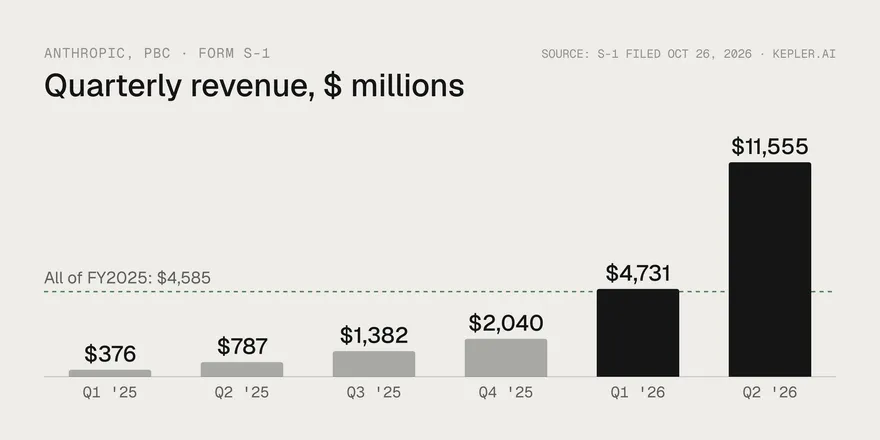
Anthropic sells access to its Claude models, mostly metered by usage, and the S-1 shows that business growing more than tenfold in both 2025 and the first half of 2026. Revenue went from $41M in 2023 to $386M in 2024 and $4,585M in 2025, then reached $16,286M in the first six months of 2026, up 1,300% on the same period a year earlier. The June 2026 quarter alone brought in $11,555M, and the March quarter ($4,731M) was larger than all of 2025. The S-1 leaves the September quarter’s dollar figure blank but says its revenue was 86 times the $197M of the December 2024 quarter, which works out to roughly $17B, more than the whole first half.
The cost side has started to bend. Compute and infrastructure, the largest expense, fell from 201% of revenue in the first half of 2025 to 55% in the first half of 2026, and the June quarter produced $974M of operating income, the first operating profit in any period the filing reports. Operating cash flow was positive at $3,929M for the half. The headline loss tells a different story: the $80.7B first-half net loss comes almost entirely from fair-value charges on financing instruments, mainly convertible notes marked up as the company’s valuation rose, which we break out below.
Against that, Anthropic has signed compute agreements far larger than its revenue. Agreements with seven compute providers that the S-1 puts a dollar figure on add up to about $637B: about $431B of minimum spend or lease rent, and about $206B of “up to” or pay-on-delivery amounts. That is before an estimated $125B to $150B of additional TPU capacity and more than $20B of AMD systems if it buys the full initial capacity, neither of which carries a fixed dollar commitment.
Key metrics snapshot
Financial summary (in millions)
| Metric | FY2023 | FY2024 | FY2025 | H1 2025 | H1 2026 |
|---|---|---|---|---|---|
| Revenue | $41 | $386 | $4,585 | $1,163 | $16,286 |
| Compute and infrastructure | $433 | $2,522 | $7,326 | $2,334 | $8,945 |
| Compute as % of revenue | 1,056% | 653% | 160% | 201% | 55% |
| Operating loss | $(551) | $(2,980) | $(8,060) | $(2,135) | $(693) |
| Adjusted operating income (loss) | $(522) | $(2,788) | $(4,854) | $(1,849) | $1,618 |
| Adjusted operating margin | (1,273)% | (722)% | (106)% | (159)% | 10% |
| Change in fair value of notes, derivatives, and SAFEs | $(1,045) | $(5,434) | $(34,308) | $(10,942) | $(72,388) |
| Net loss | $(1,531) | $(8,309) | $(41,965) | $(12,969) | $(80,748) |
| Operating cash flow | $(1,627) | $(5,692) | $(2,637) | $(1,513) | $3,929 |
| Free cash flow (operating cash flow less purchases of property and equipment) | $(1,629) | $(5,707) | $(2,768) | $(1,531) | $3,447 |
Adjusted operating income is one of the company’s non-GAAP measures: operating loss excluding stock-based compensation, non-cash charitable contributions, and the Bartz settlement. SAFEs are simple agreements for future equity.
Quarterly build (in millions)
| Metric | Q1 2025 | Q2 2025 | Q3 2025 | Q4 2025 | Q1 2026 | Q2 2026 |
|---|---|---|---|---|---|---|
| Revenue | $376 | $787 | $1,382 | $2,040 | $4,731 | $11,555 |
| Quarter-over-quarter growth | 91% | 109% | 76% | 48% | 132% | 144% |
| Compute as % of revenue | 251% | 177% | 148% | 144% | 72% | 48% |
| Operating income (loss) | $(935) | $(1,200) | $(3,089) | $(2,836) | $(1,667) | $974 |
| Adjusted operating margin | (221)% | (129)% | (93)% | (84)% | (13)% | 19% |
Operating KPIs (as of September 30, 2026)
| Metric | Value | Earlier comparison |
|---|---|---|
| Customers with $100K+ of trailing-twelve-month (TTM) revenue | More than 11,900 | More than 950 at Sept 30, 2025 |
| Customers with $1M+ of TTM revenue | More than 1,900 | n/a |
| Customers with $10M+ of TTM revenue | About 250 | n/a |
| Net revenue retention | About 900% | n/a |
| Employees | About 5,300 | Headcount up about 170% in a year |
| TTM revenue per employee | More than $6.6M | $1.4M a year earlier |
| Revenue from top five customers (first nine months of 2026) | About 25% | No single customer above 10% |
Net revenue retention is September-quarter revenue from customers active a year earlier, divided by their revenue in that year-ago quarter; it excludes Claude Pro and Max subscribers.
Company overview
Anthropic was founded in 2021 by seven co-founders, all of whom are still with the company, and is incorporated as a Delaware public benefit corporation. It describes itself as “first and foremost a research lab.” It is headquartered in San Francisco and had about 5,300 employees at September 30, 2026, a majority in research, engineering, and product development.
The product is a family of Claude models in four classes (Mythos, which includes Fable, plus Opus, Sonnet, and Haiku), each optimized for a different point on what the filing calls the capability-cost-speed curve. Customers reach those models through Claude Platform, for building their own applications, and through first-party applications, including Claude Code, the coding agent, and Claude Cowork, an agent for broader knowledge work that launched as a research preview in January 2026 and began merging with Claude.ai in September 2026.
Revenue comes in two forms. Consumption-based revenue, metered in tokens, was $13.1B, or 80% of the total, in the first half of 2026; subscriptions were $3.2B, or 20%. Customers can buy directly or through the AWS, Google Cloud, and Microsoft Azure marketplaces. Either way Anthropic holds the customer contract and books the full sale as revenue; the marketplaces, which handled 48% of first-half 2026 revenue, collect payment and pass it on net of their fees. Anthropic also leans on its own product internally: the filing says Claude wrote over 90% of the contributions to Anthropic’s codebase in September 2026.
Market opportunity
Anthropic frames its market as cognitive work. It estimates global knowledge workers’ wages, which it uses as the economic value of their work, at more than $40 trillion in 2025, cites IDC’s estimate that investment in AI solutions and services will yield a cumulative global economic impact of $22.5 trillion by 2031, and points to a knowledge-worker population IDC expects to pass one billion in 2028. It also names adjacent markets it is starting to reach, including life sciences, where IQVIA expects annual global pharmaceutical spend to exceed $2 trillion in 2026, and robotics.
The filing’s own penetration figures are small. More than half of the Fortune 500 were customers with $100,000 or more of TTM revenue at September 30, 2026, but Anthropic’s revenue from those companies averaged less than 0.1% of their total expenses in the September quarter. For its top 10 Fortune 500 customers the figure was under 1%, which the company presents as evidence of how much room remains inside accounts it already has.
Competitive position and differentiation
The S-1 names Google and OpenAI as its primary competitors among companies building frontier models for developers and enterprises, and notes that many of its rivals have greater resources and their own or greater access to compute. Four of the advantages Anthropic claims come with numbers attached:
1. Staying at the frontier. The company says most customers move to the newest model with each release; model versions released in the six months to September 30, 2026 accounted for over 80% of September-quarter revenue. The company launched 250 new model versions, platform features, and applications in the first nine months of 2026.
2. “Closing the loop.” The company says each Claude model helps build the next one. The filing ties this to engineering output as well: average daily code contributed per engineer in the September 2026 quarter was over 45 times the 2024 average.
3. Compute flexibility. Anthropic trains and serves Claude across four chip families (AWS Trainium, Google TPUs, NVIDIA GPUs, and AMD GPUs) and manages them as one pool. Q2 2026 revenue grew 1,368% year over year while compute and infrastructure expense grew 300%.
4. Enterprise depth. Over 50% of customers with $100,000 or more of TTM revenue used both Claude Platform and at least one first-party application in the September 2026 quarter, up from about 30% in the December 2025 quarter.
The complication is that the companies Anthropic depends on also compete with it. The filing says its three cloud providers (Amazon, Google, and Microsoft) are at once its investors, customers, distribution partners, and competitors, as well as compute suppliers, and flags the conflicts this could create over access to compute, its cost, and how Anthropic’s workloads are prioritized.
Growth strategy
Agents inside the enterprise. Claude Code is the template. In the September 2026 quarter, Claude Enterprise users who did not use Claude Code spent less than $75 a month on average, while the top 5% of Claude Enterprise users who did spent about 20 times that. Cowork carries the same agentic approach to non-technical teams, and the filing says its adoption outpaced Claude Code’s at the equivalent point after release.
Distribution. Direct sales and Applied AI teams handle complex accounts, but the filing says a large portion of growth has been self-service and organic. Cloud marketplaces, systems integrators, and data platforms extend reach, and Anthropic recently launched Ode with Anthropic, an AI services company formed with private equity firms to serve mid-sized companies. Sales, marketing, and partnerships expense was 19% of revenue in the first half of 2026, most of it fees paid to channel partners.
International. The company expects international expansion through regional offices and partnerships to be “a meaningful driver of revenue growth.” International customers, by billing address, accounted for $4,523M, about 28%, of first-half 2026 revenue, compared with about 29% in the first half of 2025 (27% for full-year 2025).
Owning more of the compute. Under a model it calls Anthropic Direct, the company is moving from cloud contracts alone to leasing chips directly and hosting them in dedicated facilities run on its behalf. The aim is to lock in data center capacity early, since data centers take longer to secure but are a smaller share of compute cost, and to defer the larger accelerator spend until its compute needs are more certain.
Financial analysis
Revenue and growth
First-half 2026 revenue rose $15.1B year over year, with consumption up $12.1B and subscriptions up $3.0B. Customers with $100,000 or more of TTM revenue grew from more than 600 at June 30, 2025 to more than 6,000 a year later, and revenue from that group rose from $870M to $12.0B, about three-quarters of the total in both periods. Separately, for the twelve months to September 30, 2026, revenue outside that group came from about 40 million customers spending less than $100,000 each.
Two details are worth knowing before modeling the next quarters. Spend is seasonal: total customer spend fell about 20% in the two weeks ended January 2, 2026 compared with the two weeks before. And Anthropic estimates that 5% to 7% of revenue in the first nine months of 2026 came from customers later found to be violating its usage policy or commercial terms, revenue it recognizes before cutting them off. It stepped up detection and enforcement in August and September 2026 and expects that share to decline; it says the timing and size of any hit to revenue and growth are uncertain.
Margins and the compute cycle
Most compute is contracted 12 to 18 months ahead but paid for and expensed as it comes online, so the margin line depends on how fast revenue catches up with capacity already committed. Compute and infrastructure fell from 251% of revenue in Q1 2025 to 48% in Q2 2026, and adjusted operating margin went from (221)% to 19% over the same quarters. Management warns that margins may compress again as large blocks of new compute come online, and expects heavier use of short-term compute, which costs more per unit, to compress margins in the near term.
Other expense lines are scaling with the business. Personnel cost $3,152M in the first half of 2026, including $2.2B of stock-based compensation. Sales, marketing, and partnerships rose to $3,168M, driven by a $2.7B increase in channel partner fees. A larger stock compensation charge is coming: at June 30, 2026 Anthropic had $26.6B of unrecognized compensation tied to RSUs. The registration statement becoming effective satisfies the performance condition on a significant portion of them. About $2.9B of that total relates to awards whose service condition was already wholly or partly met, which drives a catch-up charge in the quarter the offering closes; the rest is expensed over the remaining vesting periods.
Where the $80.7B net loss comes from
| Six months ended June 30, 2026 (in millions) | Amount |
|---|---|
| Operating loss | $(693) |
| Interest income | 1,111 |
| Change in fair value of convertible notes, derivative liabilities, and SAFEs | (72,388) |
| Other income (expense), net | (8,757) |
| Provision for income taxes | (21) |
| Net loss | $(80,748) |
Anthropic records its convertible notes and several other financing instruments at fair value, and changes in that value run through the income statement. For the notes, a higher company valuation means a higher fair value and a larger expense. The largest quarterly charge, $59.6B, came in the June 2026 quarter alongside the Series H financing. In its Adjusted Net Income reconciliation the company removes two of these marks for the half: $72,388M on notes, derivatives, and SAFEs, and $8,720M on other financial instruments, mostly a $9,405M loss on recognizing and remeasuring its 2026 note purchase agreements and a $39M loss on a holdback liability, partly offset by a $724M gain on warrant rights. Together they total $81,108M, more than the entire net loss. Adjusted Net Income for the half, which also adds back $2.2B of stock-based compensation and $126M of non-cash charitable contributions, was $2,671M.
At June 30, 2026, the convertible notes outstanding consisted entirely of notes issued to Amazon: $6.2B of principal, carried at a fair value of $108.6B, up from $41.7B of convertible notes on the balance sheet at December 31, 2025. Of the $132.9B accumulated deficit, $113.2B comes from fair-value changes on notes and derivative liabilities since 2023.
Cash flow and balance sheet
Operating cash flow swung from $(1,513)M in the first half of 2025 to $3,929M in the first half of 2026, driven mainly by the improvement in net loss after non-cash items and by working-capital timing: payables and accruals rose $2,679M, prepaid expenses and other assets fell $2,094M, and deferred revenue rose $1,380M, partly offset by a $4,982M rise in receivables. Purchases of property and equipment were $482M, leaving free cash flow of $3,447M by our calculation. Management expects capital spending to rise significantly as it builds its own compute, and expects operating and investing activities together to use significant cash for the foreseeable future.
The company raised $110.8B in financing cash flow in the first half of 2026, almost all from redeemable convertible preferred stock, including $45.7B of Series H-1 preferred sold in May and June 2026. At June 30 it held $112.4B of cash and cash equivalents and $19.3B of short-term investments, $131.7B in total. In September 2026 it expanded its revolving credit facility to $15B, maturing in 2031, with a requirement to keep at least $5B of liquidity at each quarter end from December 31, 2026.
Compute commitments
The S-1 leaves its headline commitment total blank. The financial statement notes give pieces of it: about $265.6B of minimum purchase commitments and $321.4B of leases not yet commenced at June 30, 2026, plus about $245B of minimum payments under agreements signed or amended since (the filing adds these, with commenced leases and short-term commitments, to reach its blank total). The agreements below sit largely inside those figures, not on top of them. The largest it describes:
Two more arrangements sit outside that total because they carry no fixed dollar amount: additional TPU capacity from providers including Google for 2028 to 2031, estimated at $125B to $150B, and AMD Helios systems from 2027, expected to exceed $20B if Anthropic buys the full initial capacity. For scale, the $431B of minimums alone is about 9 times the June quarter’s revenue annualized ($11,555M × 4 = $46.2B) and about 3.3 times cash and short-term investments at June 30.
The same partners also help fund the build-out. Note purchase agreements give Anthropic up to $77B of potential financing as of June 30, subject to conditions ($20B from Google, which could fall by up to $10B if Google buys stock alongside the IPO; $15B from Amazon, released as compute milestones are met; and $42B from Broadcom solely to fund lease rent), and AMD has committed to buy up to $5B of stock as its GPUs are delivered and deployed.
Management team and governance
Dario Amodei (CEO and co-founder) served as Vice President of Research, among other roles, at OpenAI from 2016 to 2020, after working as a senior research scientist at Google Brain, and holds a Ph.D. in biophysics from Princeton. Daniela Amodei (President, co-founder, and Chairperson) held several roles at OpenAI, including Vice President of Safety and Policy. Krishna Rao has been CFO since April 2024, after serving as CFO of Fanatics Commerce and of Cedar, and before that held corporate development and FP&A roles at Airbnb.
The board’s outside directors are Reed Hastings (lead independent director; Netflix co-founder and its CEO from 1999 to 2023), Christopher Liddell (former CFO of Microsoft and International Paper, and former Vice Chairman and CFO of General Motors), Vas Narasimhan (CEO of Novartis since 2018), and Yasmin Razavi (General Partner at Spark Capital).
The governance structure is unusual even by dual-class standards. As a public benefit corporation, Anthropic must balance the pecuniary interests of its stockholders, the best interests of those materially affected by its conduct, and its stated purpose, “the responsible development and maintenance of advanced AI for the long-term benefit of humanity.” The Long-Term Benefit Trust holds Class T stock and generally elects four of the seven board seats (at the IPO, Hastings, Narasimhan, Liddell, and one vacancy). A single Class F share, to be issued at the IPO to an LLC of the seven co-founders, will carry 50.1% of the vote on general stockholder matters, capping all Class A holders combined, the co-founders’ own Class A shares included, at 49.9%. That lasts until the “Class F Sunset Time”: 450 days after fewer than three co-founders (or their successors) have remained in the LLC for 90 days, or sooner if the share is redeemed or the LLC dissolves. Strategic partners hold non-voting Class N stock, and employees will receive Class E stock that votes only on limited matters. Anthropic will be a “controlled company” under Nasdaq rules.
Shareholder base
Ownership percentages are blank until pricing, but share counts for insiders are disclosed. Dario Amodei beneficially owns about 245.3M Class A shares, including 4.6M he votes under proxy agreements with donor-advised funds, and Daniela Amodei about 241.4M. The other five co-founders, Tom Brown, Jack Clark, Jared Kaplan, Sam McCandlish, and Christopher Olah, hold between about 231.8M and 244.2M shares each. Those five are listed under “Other Selling Stockholders,” and the number of shares each will sell is blank. Each co-founder has pledged 80% of their personal equity in Anthropic to philanthropy, a commitment the filing describes as voluntary and not legally binding.
Amazon and Google will each hold more than 5% of Anthropic’s capital stock, but in non-voting Class N shares, so neither appears in the ownership table, which covers voting stock. Amazon’s notes would convert into about 1.84B Class N shares, but conversion is capped at 12% of Anthropic’s capitalization unless Amazon waives the limit; any excess rolls into new non-interest-bearing notes. Google’s 2026 agreement carries a 14.99% cap and an option to buy up to $10B of Class N stock in a private placement at the IPO price. Spark Capital, where director Yasmin Razavi is a General Partner, invested in several rounds, including the Series H-1.
Anthropic has also contributed 846.8M Class N shares, 5% of its fully diluted shares at June 30, 2026, to the Anthropic Public Benefit Fund, a wholly owned subsidiary. After the offering the board may add up to another 2% of outstanding shares each time the stock price rises 50% above the previous milestone.
Key risks
Commitments that do not flex with revenue. About $431B of the priced compute agreements is minimum spend or lease rent owed whether or not revenue keeps up, and part of the build-out has been funded or supported by capital or credit support from certain of its cloud and chip partners.
Partners that are also competitors. Amazon, Google, and Microsoft supply compute, invest in Anthropic, resell its models, and sell their own. The filing flags the risk that these overlapping roles affect access to compute, its price, or how Anthropic’s workloads are prioritized. Sales through their marketplaces were 48% of first-half 2026 revenue, and marketplace receivables 58% of net receivables at June 30.
Customer concentration. The top five customers produced about 25% of revenue in the first nine months of 2026, and many top customers are not on long-term contracts and can cut spending at any time.
Revenue from policy violators. An estimated 5% to 7% of nine-month revenue came from customers later found to be breaking Anthropic’s usage policy or commercial terms. Detection and enforcement were stepped up in August and September 2026; the company expects that share to decline and says the timing and size of any hit to revenue and growth are uncertain.
Margin swings. New compute is expensed before the revenue it supports arrives, and short-term compute costs more. Management says operating margin may compress in periods when large blocks of capacity come online.
Content litigation. Anthropic recorded a $1.5B charge in Q3 2025 to settle the Bartz copyright class action, which the court approved in July 2026. Copyright suits from music publishers (including Concord, Universal Music Publishing Group, BMG, and Sony Music Publishing) are pending, as is a Reddit suit over the use of its data, narrowed in September 2026 to contract and unfair-competition claims. Possible statutory damages under intellectual property law add to the exposure. Anthropic says it is defending these suits vigorously.
Control and purpose. All Class A holders combined will hold at most 49.9% of the vote on general matters, the trust generally elects four of the seven board seats, and as a public benefit corporation the company is required to balance stockholders’ pecuniary interests, the interests of those materially affected by its conduct, and its public benefit purpose.
Stock compensation step-up. As of June 30, 2026, $26.6B of RSU compensation was unrecognized. Recognition starts with the IPO, with a large catch-up charge in the quarter the offering closes.
AI safety itself. The risk factors note concerns, raised within the company and by other researchers, regulators, policymakers, and industry participants, that “sufficiently advanced AI systems could, if not developed, deployed, and operated with appropriate safeguards, oversight, and security measures, pose catastrophic or existential risks to humanity,” and the company has delayed or restricted releases before (Mythos through Project Glasswing, Fable 5 with safety restrictions). The filing says such measures could slow the enterprise adoption and expansion its revenue growth depends on.
Source: Anthropic, PBC Form S-1 Registration Statement filed October 26, 2026. All financial data as disclosed therein; free cash flow, compute as a percent of revenue, quarter-over-quarter growth, implied September-quarter revenue, the international share, the commitments totals, the cash total, annualized revenue, and the multiples in the text are our calculations from those figures. Kepler uses Anthropic’s Claude models in its product; this note was prepared independently, using only the public filing, and Anthropic did not review or endorse it. For informational purposes only. Not investment advice.
Sources441 passages of the Anthropic S-1, 35 calculations
As filed with the Securities and Exchange Commission on October 26, 2026.
View the passage on EDGAR ↗See the full citation in the Kepler app ↗At the foundation of our business is our family of four Claude model classes—Mythos (including Fable), Opus, Sonnet, and Haiku—each optimized for a different point on the capability-cost-speed curve.
View the passage on EDGAR ↗See the full citation in the Kepler app ↗- View page F-7 on EDGAR ↗See the full citation in the Kepler app ↗
2023 2024 2025 H1 2025 H1 2026 Revenue 41 386 4,585 1,163 16,286 - View the passage on EDGAR ↗See the full citation in the Kepler app ↗
Q1 2025 Q2 2025 Q3 2025 Q4 2025 Q1 2026 Q2 2026 Operating income (loss) (935) (1,200) (3,089) (2,836) (1,667) 974 - View page F-7 on EDGAR ↗See the full citation in the Kepler app ↗
2023 2024 2025 H1 2025 H1 2026 Net loss (1,531) (8,309) (41,965) (12,969) (80,748) - View page F-7 on EDGAR ↗See the full citation in the Kepler app ↗
2023 2024 2025 H1 2025 H1 2026 Change in fair value of convertible notes, derivative liabilities, and SAFEs (1,045) (5,434) (34,308) (10,942) (72,388) This change was primarily driven by an increase in the fair value of our outstanding convertible promissory notes resulting from an increase in our enterprise valuation from 2025 to 2026.
View page 150 on EDGAR ↗See the full citation in the Kepler app ↗This change was primarily driven by an increase in the fair value of our outstanding convertible promissory notes resulting from an increase in our enterprise valuation from 2025 to 2026.
View the passage on EDGAR ↗See the full citation in the Kepler app ↗Pay-for-intelligence, our consumption-based revenue model, is our primary revenue model and currently represents the substantial majority of our total revenue.
View the passage on EDGAR ↗See the full citation in the Kepler app ↗Revenue growth multiple, 2025 over 2024 (x)
4,585 ÷ 386 = 11.9
See the full citation in the Kepler app ↗Revenue growth multiple, H1 2026 over H1 2025 (x)
16,286 ÷ 1,163 = 14.0
See the full citation in the Kepler app ↗Revenue growth, H1 2026 vs H1 2025 (the filing also states 1,300% on pages 62 and 148)
(16,286 ÷ 1,163 − 1) × 100 = 1,300%
See the full citation in the Kepler app ↗- View the passage on EDGAR ↗See the full citation in the Kepler app ↗
Q1 2025 Q2 2025 Q3 2025 Q4 2025 Q1 2026 Q2 2026 Revenue 376 787 1,382 2,040 4,731 11,555 Q1 2026 revenue minus full-year 2025 revenue ($M)
4,731 − 4,585 = 146
See the full citation in the Kepler app ↗our revenue increased from $197 million for the three months ended December 31, 2024 to $ for the three months ended September 30, 2026
View the passage on EDGAR ↗See the full citation in the Kepler app ↗From December 31, 2024 to September 30, 2026, our headcount grew over five times, while our revenue for the three months ended September 30, 2026 was 86 times our revenue for the three months ended December 31, 2024.
View page 183 on EDGAR ↗See the full citation in the Kepler app ↗our revenue increased from $197 million for the three months ended December 31, 2024 to $ for the three months ended September 30, 2026
View the passage on EDGAR ↗See the full citation in the Kepler app ↗Implied revenue, quarter ended Sept 30, 2026: 86 times the Dec 2024 quarter's $197M
86 × $197 million = 17 billion
- 86 timesBusiness · page 183
- $197 millionRisk Factors · page 63
Implied Sept 2026 quarter revenue minus H1 2026 revenue ($M)
86 × $197 million − 16,286 = 656
- 86 timesBusiness · page 183
- $197 millionRisk Factors · page 63
- 16,286Revenue, H1 2026 · page F-7
Compute is the most significant operating cost in our business, and compute efficiency is a critical determinant of our operating efficiency and revenue.
View the passage on EDGAR ↗See the full citation in the Kepler app ↗- View page 149 on EDGAR ↗See the full citation in the Kepler app ↗
H1 2025 H1 2026 Percentage of revenue 201 % 55 % - View the passage on EDGAR ↗See the full citation in the Kepler app ↗
2023 2024 2025 H1 2025 H1 2026 Net cash provided by (used in) operating activities (1,627) (5,692) (2,637) (1,513) 3,929 Compute agreements with a stated dollar figure, seven providers (Microsoft, Google, Amazon, Broadcom, SpaceXAI, Nscale, Lambda)
$44.9 billion + $114.5 billion + $110.0 billion + $161.2 billion + $120.5 billion + $44.6 billion + $41.3 billion = 637 billion
- at least $44.9 billionManagement's Discussion and Analysis: Infrastructure Service Arrangements · page 170
- at least approximately $114.5 billionManagement's Discussion and Analysis: Infrastructure Service Arrangements · page 170
- at least $110.0 billionManagement's Discussion and Analysis: Infrastructure Service Arrangements · page 171
- approximately $161.2 billionManagement's Discussion and Analysis: Infrastructure Equipment Leases (Broadcom) · page 171
- up to $120.5 billionManagement's Discussion and Analysis: Infrastructure Service Arrangements · page 171
- $44.6 billionManagement's Discussion and Analysis: Infrastructure Service Arrangements · page 171
- approximately $41.3 billionManagement's Discussion and Analysis: Infrastructure Service Arrangements · page 171
Minimum spend or lease rent: Microsoft, Google, Amazon (minimum spend) plus Broadcom lease rent
$44.9 billion + $114.5 billion + $110.0 billion + $161.2 billion = 431 billion
- at least $44.9 billionManagement's Discussion and Analysis: Infrastructure Service Arrangements · page 170
- at least approximately $114.5 billionManagement's Discussion and Analysis: Infrastructure Service Arrangements · page 170
- at least $110.0 billionManagement's Discussion and Analysis: Infrastructure Service Arrangements · page 171
- approximately $161.2 billionManagement's Discussion and Analysis: Infrastructure Equipment Leases (Broadcom) · page 171
"Up to" or pay-on-delivery amounts: SpaceXAI, Nscale, Lambda
$120.5 billion + $44.6 billion + $41.3 billion = 206 billion
- up to $120.5 billionManagement's Discussion and Analysis: Infrastructure Service Arrangements · page 171
- $44.6 billionManagement's Discussion and Analysis: Infrastructure Service Arrangements · page 171
- approximately $41.3 billionManagement's Discussion and Analysis: Infrastructure Service Arrangements · page 171
We estimate the aggregate future payments for such additional compute to be approximately $125.0 billion to $150.0 billion, which are not included in the contractual commitments table above.
View the passage on EDGAR ↗See the full citation in the Kepler app ↗If we procure the full amount of this initial committed capacity, we expect aggregate expenditures to exceed $20.0 billion over the term of the agreement, which are not included in the contractual commitments table above.
View the passage on EDGAR ↗See the full citation in the Kepler app ↗Excludes certain other compute and infrastructure agreements that do not specify a fixed dollar commitment which are not included in the aggregate above.
View the passage on EDGAR ↗See the full citation in the Kepler app ↗- View page F-7 on EDGAR ↗See the full citation in the Kepler app ↗
FY2023 FY2024 FY2025 H1 2025 H1 2026 Compute and infrastructure 433 2,522 7,326 2,334 8,945 - View page 148 on EDGAR ↗See the full citation in the Kepler app ↗
FY2023 FY2024 FY2025 H1 2025 H1 2026 Compute and infrastructure 1,056 653 160 201 55 - View page F-7 on EDGAR ↗See the full citation in the Kepler app ↗
2023 2024 2025 H1 2025 H1 2026 Operating loss (551) (2,980) (8,060) (2,135) (693) - View page 156 on EDGAR ↗See the full citation in the Kepler app ↗
FY2023 FY2024 FY2025 H1 2025 H1 2026 Adjusted Operating Income (Loss) (522) (2,788) (4,854) (1,849) 1,618 - View page 156 on EDGAR ↗See the full citation in the Kepler app ↗
FY2023 FY2024 FY2025 H1 2025 H1 2026 Adjusted Operating Margin (1,273)% (722)% (106)% (159)% 10 % Free cash flow, FY2023: operating cash flow less purchases of property and equipment (purchases print as a negative, so they are added)
(1,627) + (2) = (1,629)
- (1,627)Net cash provided by (used in) operating activities, 2023 · page 168
- (2)Purchases of property and equipment, FY2023 · page F-12
Free cash flow, FY2024: operating cash flow less purchases of property and equipment (purchases print as a negative, so they are added)
(5,692) + (15) = (5,707)
- (5,692)Net cash provided by (used in) operating activities, 2024 · page 168
- (15)Purchases of property and equipment, FY2024 · page F-12
Free cash flow, FY2025: operating cash flow less purchases of property and equipment (purchases print as a negative, so they are added)
(2,637) + (131) = (2,768)
- (2,637)Net cash provided by (used in) operating activities, 2025 · page 168
- (131)Purchases of property and equipment, FY2025 · page F-12
Free cash flow, H1 2025: operating cash flow less purchases of property and equipment (purchases print as a negative, so they are added)
(1,513) + (18) = (1,531)
- (1,513)Net cash provided by (used in) operating activities, H1 2025 · page 168
- (18)Purchases of property and equipment, H1 2025 · page F-12
Free cash flow, H1 2026: operating cash flow less purchases of property and equipment (purchases print as a negative, so they are added)
3,929 + (482) = 3,447
- 3,929Net cash provided by (used in) operating activities, H1 2026 · page 168
- (482)Purchases of property and equipment, H1 2026 · page F-12
we use Adjusted Operating Income (Loss), Adjusted Operating Margin, and Adjusted Net Income (Loss) as non-GAAP financial measures
View the passage on EDGAR ↗See the full citation in the Kepler app ↗We define Adjusted Operating Income (Loss) as operating loss excluding (i) stock-based compensation expense, (ii) non-cash charitable contributions, and (iii) the Bartz settlement.
View the passage on EDGAR ↗See the full citation in the Kepler app ↗We define Adjusted Operating Income (Loss) as operating loss excluding (i) stock-based compensation expense, (ii) non-cash charitable contributions, and (iii) the Bartz settlement.
View the passage on EDGAR ↗See the full citation in the Kepler app ↗We define Adjusted Operating Income (Loss) as operating loss excluding (i) stock-based compensation expense, (ii) non-cash charitable contributions, and (iii) the Bartz settlement.
View the passage on EDGAR ↗See the full citation in the Kepler app ↗Includes change in fair value of convertible notes, derivative liabilities, and simple agreements for future equity ("SAFEs")
View the passage on EDGAR ↗See the full citation in the Kepler app ↗Quarter-over-quarter revenue growth, Q1 2025 vs Q4 2024
(376 ÷ $197 million − 1) × 100 = 91%
- 376Revenue, Q1 2025 · page 157
- $197 millionRisk Factors · page 63
Quarter-over-quarter revenue growth, Q2 2025 vs Q1 2025
(787 ÷ 376 − 1) × 100 = 109%
See the full citation in the Kepler app ↗Quarter-over-quarter revenue growth, Q3 2025 vs Q2 2025
(1,382 ÷ 787 − 1) × 100 = 76%
See the full citation in the Kepler app ↗Quarter-over-quarter revenue growth, Q4 2025 vs Q3 2025
(2,040 ÷ 1,382 − 1) × 100 = 48%
See the full citation in the Kepler app ↗Quarter-over-quarter revenue growth, Q1 2026 vs Q4 2025
(4,731 ÷ 2,040 − 1) × 100 = 132%
See the full citation in the Kepler app ↗Quarter-over-quarter revenue growth, Q2 2026 vs Q1 2026
(11,555 ÷ 4,731 − 1) × 100 = 144%
See the full citation in the Kepler app ↗- View page 158 on EDGAR ↗See the full citation in the Kepler app ↗
Q1 2025 Q2 2025 Q3 2025 Q4 2025 Q1 2026 Q2 2026 Compute and infrastructure 251 177 148 144 72 48 - View page 160 on EDGAR ↗See the full citation in the Kepler app ↗
Q1 2025 Q2 2025 Q3 2025 Q4 2025 Q1 2026 Q2 2026 Adjusted Operating Margin (221)% (129)% (93)% (84)% (13)% 19 % We had more than 11,900 customers with $100,000 or more of revenue on a TTM basis as of September 30, 2026, up from more than 950 as of September 30, 2025.
View the passage on EDGAR ↗See the full citation in the Kepler app ↗We had more than 11,900 customers with $100,000 or more of revenue on a TTM basis as of September 30, 2026, up from more than 950 as of September 30, 2025.
View the passage on EDGAR ↗See the full citation in the Kepler app ↗As of September 30, 2026, we had more than 1,900 customers with $1 million or more of revenue on a TTM basis and approximately 250 customers with $10 million or more of revenue on a TTM basis.
View the passage on EDGAR ↗See the full citation in the Kepler app ↗As of September 30, 2026, we had more than 1,900 customers with $1 million or more of revenue on a TTM basis and approximately 250 customers with $10 million or more of revenue on a TTM basis.
View the passage on EDGAR ↗See the full citation in the Kepler app ↗The value that Claude delivers to customers has helped drive our Net Revenue Retention of approximately 900% as of September 30, 2026.
View the passage on EDGAR ↗See the full citation in the Kepler app ↗As of September 30, 2026, we had approximately 5,300 employees worldwide
View the passage on EDGAR ↗See the full citation in the Kepler app ↗From September 30, 2025 to September 30, 2026, TTM revenue increased approximately 1,200% while headcount increased approximately 170%, driving TTM revenue per employee from $1.4 million to over $6.6 million
View the passage on EDGAR ↗See the full citation in the Kepler app ↗From September 30, 2025 to September 30, 2026, TTM revenue increased approximately 1,200% while headcount increased approximately 170%, driving TTM revenue per employee from $1.4 million to over $6.6 million
View the passage on EDGAR ↗See the full citation in the Kepler app ↗From September 30, 2025 to September 30, 2026, TTM revenue increased approximately 1,200% while headcount increased approximately 170%, driving TTM revenue per employee from $1.4 million to over $6.6 million
View the passage on EDGAR ↗See the full citation in the Kepler app ↗our top five customers represented approximately 25% of our revenue for the nine months ended September 30, 2026
View the passage on EDGAR ↗See the full citation in the Kepler app ↗No single customer represented more than 10% of our revenue for the nine months ended September 30, 2026.
View the passage on EDGAR ↗See the full citation in the Kepler app ↗The Current Period is the three months ending as of the measurement date.
View the passage on EDGAR ↗See the full citation in the Kepler app ↗A Qualified Customer is a customer with at least $1 of revenue during the Base Period
View the passage on EDGAR ↗See the full citation in the Kepler app ↗We calculate Net Revenue Retention by dividing the Qualified Customers' Current Period revenue by their Base Period revenue.
View the passage on EDGAR ↗See the full citation in the Kepler app ↗The Base Period is the three months ending a year prior to the measurement date.
View the passage on EDGAR ↗See the full citation in the Kepler app ↗A Qualified Customer is a customer with at least $1 of revenue during the Base Period, excluding subscribers to our Claude Pro and Max plans
View the passage on EDGAR ↗See the full citation in the Kepler app ↗Anthropic was founded in 2021 by a team of researchers responsible for many of the breakthroughs that define AI
View the passage on EDGAR ↗See the full citation in the Kepler app ↗Talent attraction and retention start with our seven co-founders, all of whom have remained with the company
View the passage on EDGAR ↗See the full citation in the Kepler app ↗Talent attraction and retention start with our seven co-founders, all of whom have remained with the company
View the passage on EDGAR ↗See the full citation in the Kepler app ↗We were incorporated as a Delaware PBC in January 2021
View the passage on EDGAR ↗See the full citation in the Kepler app ↗We are first and foremost a research lab—our mission is the responsible development and maintenance of advanced AI for the long-term benefit of humanity
View the passage on EDGAR ↗See the full citation in the Kepler app ↗Our headquarters is located in San Francisco, California
View the passage on EDGAR ↗See the full citation in the Kepler app ↗As of September 30, 2026, we had approximately 5,300 employees worldwide, a majority of whom work in research, engineering, and product development functions
View the passage on EDGAR ↗See the full citation in the Kepler app ↗As of September 30, 2026, we had approximately 5,300 employees worldwide, a majority of whom work in research, engineering, and product development functions
View the passage on EDGAR ↗See the full citation in the Kepler app ↗At the foundation of our business is our family of four Claude model classes—Mythos (including Fable), Opus, Sonnet, and Haiku—each optimized for a different point on the capability-cost-speed curve
View the passage on EDGAR ↗See the full citation in the Kepler app ↗At the foundation of our business is our family of four Claude model classes—Mythos (including Fable), Opus, Sonnet, and Haiku—each optimized for a different point on the capability-cost-speed curve
View the passage on EDGAR ↗See the full citation in the Kepler app ↗At the foundation of our business is our family of four Claude model classes—Mythos (including Fable), Opus, Sonnet, and Haiku—each optimized for a different point on the capability-cost-speed curve
View the passage on EDGAR ↗See the full citation in the Kepler app ↗On top of our models, Claude Platform gives developers access to the primitives we use ourselves, which they can use to build their own AI solutions
View the passage on EDGAR ↗See the full citation in the Kepler app ↗On top of our models, Claude Platform gives developers access to the primitives we use ourselves, which they can use to build their own AI solutions
View the passage on EDGAR ↗See the full citation in the Kepler app ↗We have also built first-party applications on Claude Platform
View the passage on EDGAR ↗See the full citation in the Kepler app ↗The clearest manifestation of Virtual Collaborators today is Claude Code, our coding agent
View the passage on EDGAR ↗See the full citation in the Kepler app ↗Claude Cowork extends the same agentic architecture of Claude Code to knowledge workers broadly
View the passage on EDGAR ↗See the full citation in the Kepler app ↗As of September 30, 2026, adoption of Claude Cowork, which we made available as a research preview in January 2026, outpaced the adoption Claude Code achieved at the equivalent point following its research preview release in February 2025
View the passage on EDGAR ↗See the full citation in the Kepler app ↗In September 2026, we began merging Claude Cowork and Claude.ai, bringing agentic and conversational work into a unified application
View the passage on EDGAR ↗See the full citation in the Kepler app ↗Under this model, customers pay for usage, which is metered in tokens and priced according to the model selected
View the passage on EDGAR ↗See the full citation in the Kepler app ↗Consumption-based revenue increased from $288 million, or 75% of total revenue, for the year ended December 31, 2024, to $3.8 billion, or 83% of total revenue, for the year ended December 31, 2025, to $13.1 billion, or 80% of total revenue, for the six months ended June 30, 2026
View the passage on EDGAR ↗See the full citation in the Kepler app ↗Consumption-based revenue increased from $288 million, or 75% of total revenue, for the year ended December 31, 2024, to $3.8 billion, or 83% of total revenue, for the year ended December 31, 2025, to $13.1 billion, or 80% of total revenue, for the six months ended June 30, 2026
View page 138 on EDGAR ↗See the full citation in the Kepler app ↗Subscription-based revenue increased from $98 million, or 25% of total revenue, to $789 million, or 17% of total revenue, to $3.2 billion, or 20% of total revenue, over the same periods
View the passage on EDGAR ↗See the full citation in the Kepler app ↗Subscription-based revenue increased from $98 million, or 25% of total revenue, to $789 million, or 17% of total revenue, to $3.2 billion, or 20% of total revenue, over the same periods
View the passage on EDGAR ↗See the full citation in the Kepler app ↗We establish a direct contractual relationship with the customer and offer customers the flexibility to purchase directly from us or through CSP marketplaces, and many customers utilize both channels
View the passage on EDGAR ↗See the full citation in the Kepler app ↗For example, Claude is accessible on all three major cloud platforms—Amazon Web Services ("AWS"), Google Cloud Platform ("GCP"), and Microsoft Azure ("Azure")
View the passage on EDGAR ↗See the full citation in the Kepler app ↗In these arrangements, the Company is the principal and recognizes revenue on a gross basis because the Company has a direct contractual relationship with customers, is primarily responsible for providing the intelligence service to customers, and establishes pricing
View the passage on EDGAR ↗See the full citation in the Kepler app ↗In these arrangements, the Company is the principal and recognizes revenue on a gross basis because the Company has a direct contractual relationship with customers, is primarily responsible for providing the intelligence service to customers, and establishes pricing
View the passage on EDGAR ↗See the full citation in the Kepler app ↗These platforms bill end customers, collect payments on our behalf, and remit such amounts to us, net of applicable platform and other fees
View the passage on EDGAR ↗See the full citation in the Kepler app ↗For example, over 90% of the contributions to our codebase in September 2026 were written by Claude
View page 196 on EDGAR ↗See the full citation in the Kepler app ↗Frontier AI is transforming cognitive work—the application of knowledge, reasoning, and judgment to produce economic value
View the passage on EDGAR ↗See the full citation in the Kepler app ↗Certain estimates in this prospectus regarding global knowledge workers' wages, which we refer to as the annual economic value represented by global knowledge workers, are our own, derived from third-party data
View the passage on EDGAR ↗See the full citation in the Kepler app ↗We believe the work that knowledge workers perform represented more than $40 trillion in economic value globally in 2025
View the passage on EDGAR ↗See the full citation in the Kepler app ↗International Data Corporation ("IDC") estimates that investment in AI solutions and services will yield a cumulative global economic impact of $22.5 trillion by 2031
View the passage on EDGAR ↗See the full citation in the Kepler app ↗International Data Corporation ("IDC") estimates that investment in AI solutions and services will yield a cumulative global economic impact of $22.5 trillion by 2031
View the passage on EDGAR ↗See the full citation in the Kepler app ↗IDC, Worldwide Developer Population Growth Forecast, 2025-2029, doc # US53789825, September 2025
View the passage on EDGAR ↗See the full citation in the Kepler app ↗our aim is to continue extending them to knowledge workers globally, a population that is estimated to exceed one billion in 2028
View the passage on EDGAR ↗See the full citation in the Kepler app ↗For example, in the life sciences sector, where annual global pharmaceutical spend is expected to exceed $2 trillion in 2026
View the passage on EDGAR ↗See the full citation in the Kepler app ↗IQVIA Institute for Human Data Science, Global Medicine Use Trends 2026, February 2026
View the passage on EDGAR ↗See the full citation in the Kepler app ↗For example, in the life sciences sector, where annual global pharmaceutical spend is expected to exceed $2 trillion in 2026
View the passage on EDGAR ↗See the full citation in the Kepler app ↗We are also extending Claude into robotics, where our Model Hardware Standard enables AI agents to operate lab and manufacturing equipment such as microscopes, liquid handlers, and off-the-shelf robotic arms
View the passage on EDGAR ↗See the full citation in the Kepler app ↗Over 50% of the Fortune 500 and over 30% of the Global 2000 were customers with $100,000 or more of revenue on a TTM basis as of September 30, 2026
View the passage on EDGAR ↗See the full citation in the Kepler app ↗We believe we are in the early stages of our expansion within these customers, with our revenue from these Fortune 500 customers representing, on average, less than 0.1% of their total expenses for the three months ended September 30, 2026
View the passage on EDGAR ↗See the full citation in the Kepler app ↗For the three months ended September 30, 2026, revenue from our top 10 Fortune 500 customers represented, on average, less than 1% of their total expenses
View the passage on EDGAR ↗See the full citation in the Kepler app ↗We believe the difference reflects the substantial runway we have to deepen adoption, both within our largest customers and within customers earlier in their adoption of Claude
View the passage on EDGAR ↗See the full citation in the Kepler app ↗Our primary competitors in this category include Alphabet Inc. (together with its affiliates, "Google") and OpenAI Group PBC ("OpenAI")
View the passage on EDGAR ↗See the full citation in the Kepler app ↗We compete directly with companies developing frontier models for third-party software developers and enterprises
View the passage on EDGAR ↗See the full citation in the Kepler app ↗Many have substantially greater financial, technical, and marketing resources than we do, their own or greater access to sources of compute, longer operating histories, greater brand recognition
View the passage on EDGAR ↗See the full citation in the Kepler app ↗Many have substantially greater financial, technical, and marketing resources than we do, their own or greater access to sources of compute, longer operating histories, greater brand recognition
View the passage on EDGAR ↗See the full citation in the Kepler app ↗With each release, we have seen most customers utilize the latest version of our models, reinforcing the direct relationship between frontier model quality and revenue generation
View the passage on EDGAR ↗See the full citation in the Kepler app ↗For example, model versions released in the six months ended September 30, 2026 accounted for over 80% of our revenue for the three months ended September 30, 2026
View the passage on EDGAR ↗See the full citation in the Kepler app ↗In the nine months ended September 30, 2026, we launched an aggregate of 250 new model versions, platform features, and applications
View the passage on EDGAR ↗See the full citation in the Kepler app ↗Each version of a Claude model assists in building the next, helping to compress development timelines and produce compounding improvements in the speed at which we innovate
View the passage on EDGAR ↗See the full citation in the Kepler app ↗As a result, the average daily volume of code contributed to our codebase per engineer in the three months ended September 30, 2026 was over 45 times the average daily volume in the year ended December 31, 2024
View the passage on EDGAR ↗See the full citation in the Kepler app ↗We train and serve Claude natively across four major chip families (AWS Trainium, Google TPUs, NVIDIA GPUs, and AMD GPUs) using a proprietary orchestration layer that enables us to optimize workloads for price and performance
View the passage on EDGAR ↗See the full citation in the Kepler app ↗We train and serve Claude natively across four major chip families (AWS Trainium, Google TPUs, NVIDIA GPUs, and AMD GPUs) using a proprietary orchestration layer that enables us to optimize workloads for price and performance
View the passage on EDGAR ↗See the full citation in the Kepler app ↗We manage compute as a single, fungible pool from multiple strategic partners
View the passage on EDGAR ↗See the full citation in the Kepler app ↗Our compute efficiency is demonstrated by revenue that grew 1,368% year over year for the three months ended June 30, 2026 compared to compute and infrastructure expenses that grew 300% during the same period
View page 182 on EDGAR ↗See the full citation in the Kepler app ↗Our compute efficiency is demonstrated by revenue that grew 1,368% year over year for the three months ended June 30, 2026 compared to compute and infrastructure expenses that grew 300% during the same period
View page 182 on EDGAR ↗See the full citation in the Kepler app ↗For the three months ended September 30, 2026, over 50% of our customers with $100,000 or more of revenue on a TTM basis used Claude Platform and at least one of our first-party applications, up from approximately 30% for the three months ended December 31, 2025
View the passage on EDGAR ↗See the full citation in the Kepler app ↗For the three months ended September 30, 2026, over 50% of our customers with $100,000 or more of revenue on a TTM basis used Claude Platform and at least one of our first-party applications, up from approximately 30% for the three months ended December 31, 2025
View the passage on EDGAR ↗See the full citation in the Kepler app ↗We rely on a limited number of CSPs—Amazon.com, Inc. (together with its affiliates, "Amazon"), Google, and Microsoft Corporation ("Microsoft")—and suppliers, such as Broadcom, for compute and critical components of our compute infrastructure
View the passage on EDGAR ↗See the full citation in the Kepler app ↗Our relationships with our strategic partners—whether with these CSPs, who simultaneously serve as our investors, customers, distribution partners, and competitors, or with Broadcom, which simultaneously serves as a supplier and lessor—create potential conflicts of interest that are difficult to fully anticipate or mitigate
View the passage on EDGAR ↗See the full citation in the Kepler app ↗We rely on a limited number of CSPs—Amazon.com, Inc. (together with its affiliates, "Amazon"), Google, and Microsoft Corporation ("Microsoft")—and suppliers, such as Broadcom, for compute and critical components of our compute infrastructure
View the passage on EDGAR ↗See the full citation in the Kepler app ↗These multifaceted relationships could give rise to conflicts of interest or competitive dynamics that adversely affect our access to compute, its cost, or the prioritization of our workloads
View the passage on EDGAR ↗See the full citation in the Kepler app ↗For example, in the three months ended September 30, 2026, Claude Enterprise users who did not use Claude Code spent less than $75 per month on average, while the top 5% of Claude Enterprise users who used Claude Code spent approximately 20 times that amount
View the passage on EDGAR ↗See the full citation in the Kepler app ↗For example, in the three months ended September 30, 2026, Claude Enterprise users who did not use Claude Code spent less than $75 per month on average, while the top 5% of Claude Enterprise users who used Claude Code spent approximately 20 times that amount
View the passage on EDGAR ↗See the full citation in the Kepler app ↗For example, in the three months ended September 30, 2026, Claude Enterprise users who did not use Claude Code spent less than $75 per month on average, while the top 5% of Claude Enterprise users who used Claude Code spent approximately 20 times that amount
View the passage on EDGAR ↗See the full citation in the Kepler app ↗We are already seeing this pattern play out with non-technical teams increasingly adopting Claude Code and Claude Cowork to manage their own workflows
View the passage on EDGAR ↗See the full citation in the Kepler app ↗As of September 30, 2026, adoption of Claude Cowork, which we made available as a research preview in January 2026, outpaced the adoption Claude Code achieved at the equivalent point following its research preview release in February 2025
View the passage on EDGAR ↗See the full citation in the Kepler app ↗This organic adoption is complemented and enhanced through our direct go-to-market teams who help scale Claude to organizations with complex workflows and business processes
View the passage on EDGAR ↗See the full citation in the Kepler app ↗Our Applied AI teams embed more deeply with select customers, building solutions that make it easier for organizations to benefit from Claude's intelligence
View the passage on EDGAR ↗See the full citation in the Kepler app ↗A large portion of our growth to date has been self-service and organic
View the passage on EDGAR ↗See the full citation in the Kepler app ↗As AI adoption extends further into enterprises and more regulated industries, we are investing in direct go-to-market, Applied AI teams, and partnerships across all three major cloud platforms, SIs, consultants, and data platforms
View the passage on EDGAR ↗See the full citation in the Kepler app ↗Ode with Anthropic will partner closely with our Applied AI and go-to-market teams
View the passage on EDGAR ↗See the full citation in the Kepler app ↗We recently launched an AI services company in partnership with leading private equity firms to bring Claude's capabilities to mid-sized companies across sectors
View the passage on EDGAR ↗See the full citation in the Kepler app ↗We recently launched an AI services company in partnership with leading private equity firms to bring Claude's capabilities to mid-sized companies across sectors
View the passage on EDGAR ↗See the full citation in the Kepler app ↗We recently launched an AI services company in partnership with leading private equity firms to bring Claude's capabilities to mid-sized companies across sectors
View the passage on EDGAR ↗See the full citation in the Kepler app ↗Together, these approaches have led to a structurally efficient approach to facilitating the diffusion of Claude in the economy, with our sales, marketing, and partnerships expenses representing 19% of revenue for the six months ended June 30, 2026
View the passage on EDGAR ↗See the full citation in the Kepler app ↗Sales, marketing, and partnerships expenses primarily consist of fees paid to channel partners and marketing and advertising costs, including media and public relations spend
View the passage on EDGAR ↗See the full citation in the Kepler app ↗We are also expanding our ability to serve international customers through the growth of regional offices and partnerships in key markets, and we expect international expansion to be a meaningful driver of revenue growth as global demand for AI accelerates
View the passage on EDGAR ↗See the full citation in the Kepler app ↗We are also expanding our ability to serve international customers through the growth of regional offices and partnerships in key markets, and we expect international expansion to be a meaningful driver of revenue growth as global demand for AI accelerates
View the passage on EDGAR ↗See the full citation in the Kepler app ↗The following table presents revenue by geographical region, determined by the billing address of the customer
View the passage on EDGAR ↗See the full citation in the Kepler app ↗- View the passage on EDGAR ↗See the full citation in the Kepler app ↗
FY2023 FY2024 FY2025 H1 2025 H1 2026 International 7 123 1,223 343 4,523 International share of revenue, H1 2026 (International / Total)
4,523 ÷ 16,286 × 100 = 28%
See the full citation in the Kepler app ↗International share of revenue, H1 2025 (International / Total)
343 ÷ 1,163 × 100 = 29%
See the full citation in the Kepler app ↗International share of revenue, FY2025 (International / Total)
1,223 ÷ 4,585 × 100 = 27%
See the full citation in the Kepler app ↗We refer to this additional source of compute as Anthropic Direct, which helps to address our scaling compute requirements and we believe will provide long-term economic advantages
View the passage on EDGAR ↗See the full citation in the Kepler app ↗In addition, as our compute needs have grown substantially, we are shifting from sourcing compute solely through fixed-term cloud agreements to a hybrid model that also includes leasing chips directly and hosting them in dedicated facilities operated on our behalf
View the passage on EDGAR ↗See the full citation in the Kepler app ↗In addition, as our compute needs have grown substantially, we are shifting from sourcing compute solely through fixed-term cloud agreements to a hybrid model that also includes leasing chips directly and hosting them in dedicated facilities operated on our behalf
View the passage on EDGAR ↗See the full citation in the Kepler app ↗Because data centers require longer lead times but represent a smaller fraction of total compute costs, this approach enables us to secure data center capacity early while deferring larger accelerator investments until our specific compute needs are more certain
View the passage on EDGAR ↗See the full citation in the Kepler app ↗Because data centers require longer lead times but represent a smaller fraction of total compute costs, this approach enables us to secure data center capacity early while deferring larger accelerator investments until our specific compute needs are more certain
View the passage on EDGAR ↗See the full citation in the Kepler app ↗Because data centers require longer lead times but represent a smaller fraction of total compute costs, this approach enables us to secure data center capacity early while deferring larger accelerator investments until our specific compute needs are more certain
View the passage on EDGAR ↗See the full citation in the Kepler app ↗Revenue for the six months ended June 30, 2026 increased by $15.1 billion, or 1,300%, compared to the six months ended June 30, 2025.
View the passage on EDGAR ↗See the full citation in the Kepler app ↗Consumption-based and subscription-based revenue increased by $12.1 billion and $3.0 billion, respectively, for the six months ended June 30, 2026 compared to the six months ended June 30, 2025.
View the passage on EDGAR ↗See the full citation in the Kepler app ↗Consumption-based and subscription-based revenue increased by $12.1 billion and $3.0 billion, respectively, for the six months ended June 30, 2026 compared to the six months ended June 30, 2025.
View the passage on EDGAR ↗See the full citation in the Kepler app ↗The number of customers with $100,000 or more of revenue on a TTM basis grew from more than 600 as of June 30, 2025 to more than 6,000 as of June 30, 2026.
View page 148 on EDGAR ↗See the full citation in the Kepler app ↗The number of customers with $100,000 or more of revenue on a TTM basis grew from more than 600 as of June 30, 2025 to more than 6,000 as of June 30, 2026.
View the passage on EDGAR ↗See the full citation in the Kepler app ↗The number of customers with $100,000 or more of revenue on a TTM basis grew from more than 600 as of June 30, 2025 to more than 6,000 as of June 30, 2026.
View page 148 on EDGAR ↗See the full citation in the Kepler app ↗Total revenue from these customers grew from $870 million for the six months ended June 30, 2025 to $12.0 billion for the six months ended June 30, 2026 and represented approximately 75% and 74% of total revenue for the six months ended June 30, 2025 and 2026, respectively.
View the passage on EDGAR ↗See the full citation in the Kepler app ↗Total revenue from these customers grew from $870 million for the six months ended June 30, 2025 to $12.0 billion for the six months ended June 30, 2026 and represented approximately 75% and 74% of total revenue for the six months ended June 30, 2025 and 2026, respectively.
View the passage on EDGAR ↗See the full citation in the Kepler app ↗for the trailing twelve months ended September 30, 2026 was generated by approximately 40 million customers, each with less than $100,000 of revenue on a TTM basis.
View the passage on EDGAR ↗See the full citation in the Kepler app ↗for the trailing twelve months ended September 30, 2026 was generated by approximately 40 million customers, each with less than $100,000 of revenue on a TTM basis.
View the passage on EDGAR ↗See the full citation in the Kepler app ↗for the trailing twelve months ended September 30, 2026 was generated by approximately 40 million customers, each with less than $100,000 of revenue on a TTM basis.
View the passage on EDGAR ↗See the full citation in the Kepler app ↗Our customer usage patterns have also typically exhibited seasonality, particularly around holiday and vacation periods in the summer and winter
View the passage on EDGAR ↗See the full citation in the Kepler app ↗Consistent with this pattern, for the two weeks ended January 2, 2026, total customer spend declined by approximately 20% compared to the prior two weeks ended December 19, 2025.
View the passage on EDGAR ↗See the full citation in the Kepler app ↗Consistent with this pattern, for the two weeks ended January 2, 2026, total customer spend declined by approximately 20% compared to the prior two weeks ended December 19, 2025.
View the passage on EDGAR ↗See the full citation in the Kepler app ↗Based on our detection and review process, we estimate that revenue from such customers represented approximately 5% to 7% of our revenue for the nine months ended September 30, 2026.
View the passage on EDGAR ↗See the full citation in the Kepler app ↗our revenue has included, and we expect will continue to include, amounts from customers that we subsequently determine are using our models, platform, and applications in violation of our usage policy or commercial terms.
View the passage on EDGAR ↗See the full citation in the Kepler app ↗Because detection, investigation, and enforcement take time, we recognize revenue from such customers when the related services are provided, before restricting or terminating their access.
View the passage on EDGAR ↗See the full citation in the Kepler app ↗We expect the percentage of revenue from customers using our models, platform, and applications in violation of our usage policy or commercial terms to decline in future periods as we have enhanced our detection and enforcement efforts, in particular in August and September 2026
View the passage on EDGAR ↗See the full citation in the Kepler app ↗We expect the percentage of revenue from customers using our models, platform, and applications in violation of our usage policy or commercial terms to decline in future periods as we have enhanced our detection and enforcement efforts, in particular in August and September 2026
View the passage on EDGAR ↗See the full citation in the Kepler app ↗however, the timing and magnitude of any resulting adverse effect on our revenue and revenue growth are uncertain.
View the passage on EDGAR ↗See the full citation in the Kepler app ↗In addition, the majority of our compute is contracted under multi-year commitments that we typically procure 12 to 18 months in advance of availability.
View the passage on EDGAR ↗See the full citation in the Kepler app ↗These expenses are paid and recognized as compute becomes available to us, rather than when committed
View the passage on EDGAR ↗See the full citation in the Kepler app ↗As a result, compute and infrastructure expenses as a percentage of revenue will depend primarily on how our revenue scales relative to our total committed compute cost base.
View the passage on EDGAR ↗See the full citation in the Kepler app ↗As significant incremental compute is brought online in future periods, the associated expense will be recognized in advance of the full revenue that the compute will ultimately support, and we expect operating margin and Adjusted Operating Margin may compress in those periods.
View the passage on EDGAR ↗See the full citation in the Kepler app ↗Compute is procured and committed in advance and the expense is incurred as it is brought online and added to our fungible pool, often in large, discrete steps.
View the passage on EDGAR ↗See the full citation in the Kepler app ↗We expect our use of short-term compute to increase in the near term and to in turn compress our operating margin and Adjusted Operating Margin as a result.
View the passage on EDGAR ↗See the full citation in the Kepler app ↗When customer demand or research needs exceed this long-term capacity, we procure short-term compute, which typically carries a higher cost per unit of compute.
View the passage on EDGAR ↗See the full citation in the Kepler app ↗We expect our use of short-term compute to increase in the near term and to in turn compress our operating margin and Adjusted Operating Margin as a result.
View the passage on EDGAR ↗See the full citation in the Kepler app ↗- View page 147 on EDGAR ↗See the full citation in the Kepler app ↗
FY2023 FY2024 FY2025 H1 2025 H1 2026 Personnel 95 454 1,839 538 3,152 Includes stock-based compensation expense of $29 million, $192 million, and $1.2 billion for the years ended December 31, 2023, 2024, and 2025, respectively, and $286 million and $2.2 billion for the six months ended June 30, 2025 and 2026, respectively.
View page 147 on EDGAR ↗See the full citation in the Kepler app ↗- View page F-7 on EDGAR ↗See the full citation in the Kepler app ↗
FY2023 FY2024 FY2025 H1 2025 H1 2026 Sales, marketing, and partnerships 2 43 568 120 3,168 The increase was primarily driven by a $2.7 billion increase in fees paid to channel partners, reflecting the growth of our business
View the passage on EDGAR ↗See the full citation in the Kepler app ↗As of June 30, 2026, there was approximately $26.6 billion of total unrecognized stock-based compensation expense related to RSUs.
View the passage on EDGAR ↗See the full citation in the Kepler app ↗as the performance-based vesting condition applicable to a significant portion of our outstanding RSUs will be satisfied upon the effectiveness of the registration statement of which this prospectus forms a part.
View the passage on EDGAR ↗See the full citation in the Kepler app ↗as the performance-based vesting condition applicable to a significant portion of our outstanding RSUs will be satisfied upon the effectiveness of the registration statement of which this prospectus forms a part.
View the passage on EDGAR ↗See the full citation in the Kepler app ↗Of that amount, $2.9 billion relates to RSUs for which the service-based vesting condition had been satisfied or partially satisfied.
View page 173 on EDGAR ↗See the full citation in the Kepler app ↗If this offering had been completed on June 30, 2026, we would have recorded $2.9 billion of cumulative stock-based compensation expense related to the RSUs on that date
View the passage on EDGAR ↗See the full citation in the Kepler app ↗stock-based compensation expense related to our RSUs will result in increases in our expenses in future periods, in particular the quarter in which this offering is completed
View the passage on EDGAR ↗See the full citation in the Kepler app ↗and an additional $23.7 billion of unrecognized stock-based compensation expense related to the RSUs, would be recognized over a weighted-average period of approximately 2.1 years.
View the passage on EDGAR ↗See the full citation in the Kepler app ↗- View page F-7 on EDGAR ↗See the full citation in the Kepler app ↗
FY2023 FY2024 FY2025 H1 2025 H1 2026 Interest income 69 106 431 115 1,111 - View page F-7 on EDGAR ↗See the full citation in the Kepler app ↗
FY2023 FY2024 FY2025 H1 2025 H1 2026 Other income (expense), net (2) — (8) — (8,757) - View page F-7 on EDGAR ↗See the full citation in the Kepler app ↗
FY2023 FY2024 FY2025 H1 2025 H1 2026 Provision for income taxes 2 1 20 7 21 Change in fair value of convertible notes, derivative liabilities, and SAFEs consists of gains and losses as a result of recording our convertible promissory notes, derivative liabilities, and SAFE liabilities at fair value at the end of each reporting period.
View the passage on EDGAR ↗See the full citation in the Kepler app ↗Recorded at fair value with changes in fair value recorded in earnings due to the election of the fair value option of accounting for financial instruments.
View the passage on EDGAR ↗See the full citation in the Kepler app ↗Because these instruments are marked to market, increases in our enterprise valuation drive increases in this expense.
View the passage on EDGAR ↗See the full citation in the Kepler app ↗The expense was largest in the three months ended June 30, 2026, reflecting the increase in our enterprise valuation in connection with our Series H financing.
View the passage on EDGAR ↗See the full citation in the Kepler app ↗- View the passage on EDGAR ↗See the full citation in the Kepler app ↗
Q1 2025 Q2 2025 Q3 2025 Q4 2025 Q1 2026 Q2 2026 Change in fair value of convertible notes, derivative liabilities, and SAFEs (5,701) (5,241) (9,165) (14,201) (12,791) (59,597) The expense was largest in the three months ended June 30, 2026, reflecting the increase in our enterprise valuation in connection with our Series H financing.
View the passage on EDGAR ↗See the full citation in the Kepler app ↗- View page 156 on EDGAR ↗See the full citation in the Kepler app ↗
FY2023 FY2024 FY2025 H1 2025 H1 2026 Change in fair value of convertible notes, derivative liabilities, and SAFEs 1,045 5,434 34,308 10,942 72,388 - View the passage on EDGAR ↗See the full citation in the Kepler app ↗
FY2023 FY2024 FY2025 H1 2025 H1 2026 Change in fair value of certain mark-to-market financial instruments — — 3 — 8,720 - View the passage on EDGAR ↗See the full citation in the Kepler app ↗
2023 2024 2025 H1 2025 H1 2026 Recognition and change in fair value of note purchase agreements — — — — (9,405) - View the passage on EDGAR ↗See the full citation in the Kepler app ↗
FY2023 FY2024 FY2025 H1 2025 H1 2026 Change in fair value of holdback liability — — (3) — (39) - View page F-37 on EDGAR ↗See the full citation in the Kepler app ↗
FY2023 FY2024 FY2025 H1 2025 H1 2026 Change in fair value of warrant rights — — — — 724 Fair-value marks removed in the Adjusted Net Income reconciliation, H1 2026 (notes, derivatives, and SAFEs plus certain mark-to-market financial instruments)
72,388 + 8,720 = 81,108
- 72,388Change in fair value of convertible notes, derivative liabilities, and SAFEs, H1 2026 · page 156
- 8,720Change in fair value of certain mark-to-market financial instruments, H1 2026 · page 156
- View the passage on EDGAR ↗See the full citation in the Kepler app ↗
FY2023 FY2024 FY2025 H1 2025 H1 2026 Stock-based compensation expense 29 192 1,165 286 2,185 - View page 156 on EDGAR ↗See the full citation in the Kepler app ↗
FY2023 FY2024 FY2025 H1 2025 H1 2026 Non-cash charitable contributions — — 541 — 126 - View page 156 on EDGAR ↗See the full citation in the Kepler app ↗
FY2023 FY2024 FY2025 H1 2025 H1 2026 Adjusted Net Income (Loss) (457) (2,683) (4,448) (1,741) 2,671 The following table summarizes the notes outstanding under our NPAs as of June 30, 2026, which consist entirely of non-interest-bearing rollover notes issued to Amazon
View the passage on EDGAR ↗See the full citation in the Kepler app ↗pursuant to which we previously issued convertible promissory notes, approximately $6.2 billion aggregate principal amount of which remains outstanding
View the passage on EDGAR ↗See the full citation in the Kepler app ↗- View the passage on EDGAR ↗See the full citation in the Kepler app ↗
Dec 31, 2024 Dec 31, 2025 Jun 30, 2026 Convertible notes payable 14,116 41,677 108,566 - View page F-6 on EDGAR ↗See the full citation in the Kepler app ↗
Dec 31, 2024 Dec 31, 2025 Jun 30, 2026 Accumulated deficit (10,040) (52,154) (132,902) We have generated losses from our operations, as reflected in our accumulated deficit of $132.9 billion, which includes $113.2 billion related to changes in the fair value of our convertible notes driven by increases in our enterprise valuation and derivative liabilities since 2023
View the passage on EDGAR ↗See the full citation in the Kepler app ↗The increase in operating cash flow was primarily driven by an improvement in net loss adjusted for non-cash items, and changes in working capital, primarily reflecting the timing of payments to vendors and cash receipts from customers.
View the passage on EDGAR ↗See the full citation in the Kepler app ↗The increase in operating cash flow was primarily driven by an improvement in net loss adjusted for non-cash items, and changes in working capital, primarily reflecting the timing of payments to vendors and cash receipts from customers.
View the passage on EDGAR ↗See the full citation in the Kepler app ↗- View the passage on EDGAR ↗See the full citation in the Kepler app ↗
FY2023 FY2024 FY2025 H1 2025 H1 2026 Accounts payable, accrued expenses, and other liabilities 84 222 2,079 257 2,679 - View the passage on EDGAR ↗See the full citation in the Kepler app ↗
FY2023 FY2024 FY2025 H1 2025 H1 2026 Prepaid expenses and other assets (1,253) (3,190) 1,771 212 2,094 - View page F-12 on EDGAR ↗See the full citation in the Kepler app ↗
FY2023 FY2024 FY2025 H1 2025 H1 2026 Deferred revenue 7 21 241 124 1,380 - View the passage on EDGAR ↗See the full citation in the Kepler app ↗
FY2023 FY2024 FY2025 H1 2025 H1 2026 Accounts receivable, net (10) (90) (834) (384) (4,982) - View the passage on EDGAR ↗See the full citation in the Kepler app ↗
FY2023 FY2024 FY2025 H1 2025 H1 2026 Purchases of property and equipment (2) (15) (131) (18) (482) We expect our capital expenditures to increase significantly as we expand our build-out, and we expect these investments to result in significant net cash used in operating and investing activities for the foreseeable future.
View the passage on EDGAR ↗See the full citation in the Kepler app ↗We continue to invest in our own data center infrastructure and enter into compute and infrastructure capacity arrangements to support anticipated demand for our intelligence service.
View the passage on EDGAR ↗See the full citation in the Kepler app ↗We expect our capital expenditures to increase significantly as we expand our build-out, and we expect these investments to result in significant net cash used in operating and investing activities for the foreseeable future.
View the passage on EDGAR ↗See the full citation in the Kepler app ↗- View page F-12 on EDGAR ↗See the full citation in the Kepler app ↗
FY2023 FY2024 FY2025 H1 2025 H1 2026 Net cash provided by financing activities 2,320 7,248 19,960 4,749 110,774 - View the passage on EDGAR ↗See the full citation in the Kepler app ↗
FY2023 FY2024 FY2025 H1 2025 H1 2026 Proceeds from issuance of redeemable convertible preferred stock, net of issuance costs 445 1,188 16,548 3,549 110,432 From May 2026 to June 2026, we sold an aggregate of (i) 77,637,878 shares of our Series H-1 redeemable convertible preferred stock to 305 accredited investors at a purchase price of $589.0095 per share, for an aggregate purchase price of approximately $45.7 billion
View page II-4 on EDGAR ↗See the full citation in the Kepler app ↗From May 2026 to June 2026, we sold an aggregate of (i) 77,637,878 shares of our Series H-1 redeemable convertible preferred stock to 305 accredited investors at a purchase price of $589.0095 per share, for an aggregate purchase price of approximately $45.7 billion
View the passage on EDGAR ↗See the full citation in the Kepler app ↗- View the passage on EDGAR ↗See the full citation in the Kepler app ↗
Dec 31, 2024 Dec 31, 2025 Jun 30, 2026 Cash and cash equivalents 3,141 17,388 112,389 - View the passage on EDGAR ↗See the full citation in the Kepler app ↗
Dec 31, 2024 Dec 31, 2025 Jun 30, 2026 Short-term investments — 2,889 19,262 Cash and cash equivalents plus short-term investments, June 30, 2026
112,389 + 19,262 = 131.7 billion
- 112,389Cash and cash equivalents, Jun 30, 2026 · page F-5
- 19,262Short-term investments, Jun 30, 2026 · page F-5
In September 2026, we entered into an Amended and Restated Credit Agreement (the "A&R Credit Agreement"), which amended and restated the Credit Agreement to provide for a $15 billion senior secured revolving credit facility
View the passage on EDGAR ↗See the full citation in the Kepler app ↗In September 2026, we entered into an Amended and Restated Credit Agreement (the "A&R Credit Agreement"), which amended and restated the Credit Agreement to provide for a $15 billion senior secured revolving credit facility
View the passage on EDGAR ↗See the full citation in the Kepler app ↗The A&R Credit Facility will mature on September 4, 2031, subject to earlier springing maturity if more than $500 million in aggregate scheduled cash principal payments on certain of our indebtedness are required
View the passage on EDGAR ↗See the full citation in the Kepler app ↗The A&R Credit Agreement includes a financial covenant requiring that we maintain liquidity of at least $5.0 billion as of the last day of each fiscal quarter, beginning with the fiscal quarter ending December 31, 2026.
View the passage on EDGAR ↗See the full citation in the Kepler app ↗The A&R Credit Agreement includes a financial covenant requiring that we maintain liquidity of at least $5.0 billion as of the last day of each fiscal quarter, beginning with the fiscal quarter ending December 31, 2026.
View the passage on EDGAR ↗See the full citation in the Kepler app ↗In aggregate, the contractual obligations in the table below plus the short-term and subsequent commitments, as well as leases not yet commenced, each described in the paragraphs below are approximately $ , substantially all of which is related to compute and infrastructure.
View the passage on EDGAR ↗See the full citation in the Kepler app ↗As of June 30, 2026 (unaudited), expected future fixed or minimum guaranteed commitments under these agreements were approximately $265.6 billion with terms ranging from one to 20 years.
View the passage on EDGAR ↗See the full citation in the Kepler app ↗As of December 31, 2025 and June 30, 2026 (unaudited), the Company had entered into lease agreements primarily related to compute and infrastructure capacity that had not yet commenced, with total estimated future undiscounted lease obligations of approximately $50.2 billion and $321.4 billion, respectively
View the passage on EDGAR ↗See the full citation in the Kepler app ↗subsequent to June 30, 2026, the Company entered into new, and amended existing, lease and commercial agreements primarily to secure additional compute and infrastructure capacity, with aggregate future minimum payment obligations of approximately $245 billion
View page F-65 on EDGAR ↗See the full citation in the Kepler app ↗subsequent to June 30, 2026, the Company entered into new, and amended existing, lease and commercial agreements primarily to secure additional compute and infrastructure capacity, with aggregate future minimum payment obligations of approximately $245 billion
View the passage on EDGAR ↗See the full citation in the Kepler app ↗In aggregate, the contractual obligations in the table below plus the short-term and subsequent commitments, as well as leases not yet commenced, each described in the paragraphs below are approximately $ , substantially all of which is related to compute and infrastructure.
View the passage on EDGAR ↗See the full citation in the Kepler app ↗Our rent payments over the life of these leases are equal to an aggregate of approximately $161.2 billion excluding interest, with rent payable in quarterly installments
View the passage on EDGAR ↗See the full citation in the Kepler app ↗We have entered into five-year master equipment leases with Broadcom, pursuant to which we receive such hardware for deployment in dedicated data center facilities operated by others on our behalf
View the passage on EDGAR ↗See the full citation in the Kepler app ↗The Lease Arrangements provide us with access to TPU-based compute capacity, a portion of which began to come online in 2026, with additional capacity expected to come online starting in 2027.
View the passage on EDGAR ↗See the full citation in the Kepler app ↗The Lease Arrangements are non-cancelable by either party during the applicable lease period except in the case of a default.
View the passage on EDGAR ↗See the full citation in the Kepler app ↗Under the SpaceXAI Arrangements, we agreed to spend an aggregate of up to $120.5 billion over terms extending into 2029, consisting of approximately $3.1 billion in the aggregate per month once all capacity has been delivered, which we expect in December 2026, with different fees during capacity ramping periods.
View the passage on EDGAR ↗See the full citation in the Kepler app ↗Under the SpaceXAI Arrangements, we agreed to spend an aggregate of up to $120.5 billion over terms extending into 2029, consisting of approximately $3.1 billion in the aggregate per month once all capacity has been delivered, which we expect in December 2026, with different fees during capacity ramping periods.
View the passage on EDGAR ↗See the full citation in the Kepler app ↗Under the SpaceXAI Arrangements, we agreed to spend an aggregate of up to $120.5 billion over terms extending into 2029, consisting of approximately $3.1 billion in the aggregate per month once all capacity has been delivered, which we expect in December 2026, with different fees during capacity ramping periods.
View the passage on EDGAR ↗See the full citation in the Kepler app ↗Under the SpaceXAI Arrangements, we agreed to spend an aggregate of up to $120.5 billion over terms extending into 2029, consisting of approximately $3.1 billion in the aggregate per month once all capacity has been delivered, which we expect in December 2026, with different fees during capacity ramping periods.
View the passage on EDGAR ↗See the full citation in the Kepler app ↗Following initial non- cancelable periods ending in January 2027 and March 2027 under the respective agreements, each agreement may be cancelled by either party upon 90 days' advance written notice.
View the passage on EDGAR ↗See the full citation in the Kepler app ↗Following initial non- cancelable periods ending in January 2027 and March 2027 under the respective agreements, each agreement may be cancelled by either party upon 90 days' advance written notice.
View the passage on EDGAR ↗See the full citation in the Kepler app ↗In March 2026, we entered into an agreement with Google, which was subsequently amended between May and August 2026, and pursuant to which we committed to spend at least approximately $114.5 billion between April 2026 and July 2033, regardless of actual usage.
View the passage on EDGAR ↗See the full citation in the Kepler app ↗In March 2026, we entered into an agreement with Google, which was subsequently amended between May and August 2026, and pursuant to which we committed to spend at least approximately $114.5 billion between April 2026 and July 2033, regardless of actual usage.
View the passage on EDGAR ↗See the full citation in the Kepler app ↗Our commitments under such agreement are non-cancelable except in the event of Google's uncured material breach.
View the passage on EDGAR ↗See the full citation in the Kepler app ↗In April 2026, we entered into an agreement with Amazon, pursuant to which we committed to spend an aggregate of at least $110.0 billion between May 2026 and April 2036, regardless of actual usage.
View the passage on EDGAR ↗See the full citation in the Kepler app ↗In April 2026, we entered into an agreement with Amazon, pursuant to which we committed to spend an aggregate of at least $110.0 billion between May 2026 and April 2036, regardless of actual usage.
View the passage on EDGAR ↗See the full citation in the Kepler app ↗Our commitment under such agreement is non-cancelable except in the event of Amazon's uncured material breach.
View the passage on EDGAR ↗See the full citation in the Kepler app ↗In November 2025, we entered into an agreement with Microsoft, which was subsequently amended in February and October 2026, pursuant to which we committed to spend an aggregate of at least $44.9 billion between November 2026 and May 2033, regardless of actual usage.
View the passage on EDGAR ↗See the full citation in the Kepler app ↗In November 2025, we entered into an agreement with Microsoft, which was subsequently amended in February and October 2026, pursuant to which we committed to spend an aggregate of at least $44.9 billion between November 2026 and May 2033, regardless of actual usage.
View the passage on EDGAR ↗See the full citation in the Kepler app ↗Our commitment under such agreement is non-cancelable except in the event of Microsoft's uncured material breach or, on a per-tranche basis, for undelivered tranches.
View the passage on EDGAR ↗See the full citation in the Kepler app ↗Under the Nscale Services Agreements, we agreed to spend an aggregate of up to approximately $44.6 billion over terms extending into 2033, with fees accruing only as capacity is delivered to and accepted by us.
View the passage on EDGAR ↗See the full citation in the Kepler app ↗Under the Nscale Services Agreements, we agreed to spend an aggregate of up to approximately $44.6 billion over terms extending into 2033, with fees accruing only as capacity is delivered to and accepted by us.
View the passage on EDGAR ↗See the full citation in the Kepler app ↗Under the Nscale Services Agreements, we agreed to spend an aggregate of up to approximately $44.6 billion over terms extending into 2033, with fees accruing only as capacity is delivered to and accepted by us.
View the passage on EDGAR ↗See the full citation in the Kepler app ↗Otherwise, our commitment under each agreement is non-cancelable except in limited circumstances, including Nscale's failure to meet specified delivery or service availability requirements or an uncured material breach by the applicable Nscale entity.
View the passage on EDGAR ↗See the full citation in the Kepler app ↗Nscale is required to use best efforts to obtain qualifying financing for the NVIDIA GPUs and data center infrastructure within a specified period following the effective date of such agreements
View the passage on EDGAR ↗See the full citation in the Kepler app ↗Under the Lambda Agreements, we agreed to spend an aggregate of approximately $41.3 billion over terms extending into 2034, with fees accruing only as capacity is delivered to and accepted by us.
View the passage on EDGAR ↗See the full citation in the Kepler app ↗Under the Lambda Agreements, we agreed to spend an aggregate of approximately $41.3 billion over terms extending into 2034, with fees accruing only as capacity is delivered to and accepted by us.
View the passage on EDGAR ↗See the full citation in the Kepler app ↗Under the Lambda Agreements, we agreed to spend an aggregate of approximately $41.3 billion over terms extending into 2034, with fees accruing only as capacity is delivered to and accepted by us.
View the passage on EDGAR ↗See the full citation in the Kepler app ↗Otherwise, our commitment under each of the Lambda Agreements is non- cancelable except in the event of Lambda's uncured material breach or certain other limited circumstances
View the passage on EDGAR ↗See the full citation in the Kepler app ↗Under our August 2026 agreement, which represents approximately $34.9 billion of the aggregate commitment, either party may terminate if Lambda does not timely secure the facility lease.
View the passage on EDGAR ↗See the full citation in the Kepler app ↗Under our August 2026 agreement, which represents approximately $34.9 billion of the aggregate commitment, either party may terminate if Lambda does not timely secure the facility lease.
View the passage on EDGAR ↗See the full citation in the Kepler app ↗Minimum spend or lease rent: Broadcom + Google + Amazon + Microsoft (in millions)
$161.2 billion + $114.5 billion + $110.0 billion + $44.9 billion = 431 billion
- approximately $161.2 billion excluding interestManagement's Discussion and Analysis — Infrastructure Equipment Leases · page 171
- at least approximately $114.5 billionManagement's Discussion and Analysis: Infrastructure Service Arrangements · page 170
- at least $110.0 billionManagement's Discussion and Analysis: Infrastructure Service Arrangements · page 171
- at least $44.9 billionManagement's Discussion and Analysis: Infrastructure Service Arrangements · page 170
Up-to or billed-on-delivery amounts: SpaceXAI + Nscale + Lambda (in millions)
$120.5 billion + $44.6 billion + $41.3 billion = 206 billion
- up to $120.5 billionManagement's Discussion and Analysis — Infrastructure Service Arrangements · page 171
- $44.6 billionManagement's Discussion and Analysis: Infrastructure Service Arrangements · page 171
- approximately $41.3 billionManagement's Discussion and Analysis: Infrastructure Service Arrangements · page 171
Sum of the seven stated agreement amounts (in millions)
$161.2 billion + $114.5 billion + $110.0 billion + $44.9 billion + $120.5 billion + $44.6 billion + $41.3 billion = 637 billion
- approximately $161.2 billion excluding interestManagement's Discussion and Analysis — Infrastructure Equipment Leases · page 171
- at least approximately $114.5 billionManagement's Discussion and Analysis: Infrastructure Service Arrangements · page 170
- at least $110.0 billionManagement's Discussion and Analysis: Infrastructure Service Arrangements · page 171
- at least $44.9 billionManagement's Discussion and Analysis: Infrastructure Service Arrangements · page 170
- up to $120.5 billionManagement's Discussion and Analysis — Infrastructure Service Arrangements · page 171
- $44.6 billionManagement's Discussion and Analysis: Infrastructure Service Arrangements · page 171
- approximately $41.3 billionManagement's Discussion and Analysis: Infrastructure Service Arrangements · page 171
In addition, we also committed to procure additional TPU compute from TPU providers, including Google, to be delivered between 2028 and 2031.
View the passage on EDGAR ↗See the full citation in the Kepler app ↗In addition, we also committed to procure additional TPU compute from TPU providers, including Google, to be delivered between 2028 and 2031.
View the passage on EDGAR ↗See the full citation in the Kepler app ↗Under the Hardware Supply Agreement with AMD, we committed to obtain an initial tranche of compute capacity in calendar year 2027 by purchasing AMD-based Helios rack-scale systems from approved manufacturers
View the passage on EDGAR ↗See the full citation in the Kepler app ↗Minimum commitments ($431B) as a multiple of annualized June 2026 quarter revenue
431 billion ÷ 46.2 billion = 9
- 431 billionMinimum spend or lease rent: Broadcom + Google + Amazon + Microsoft (in millions)
- 46.2 billionJune 2026 quarter revenue annualized (in millions)
- View the passage on EDGAR ↗See the full citation in the Kepler app ↗
Q1 2025 Q2 2025 Q3 2025 Q4 2025 Q1 2026 Q2 2026 Revenue 376 787 1,382 2,040 4,731 11,555 June 2026 quarter revenue annualized (in millions)
11,555 × 4 = 46.2 billion
- 11,555Revenue, Q2 2026 · page 157
Minimum commitments ($431B) as a multiple of cash and short-term investments at June 30, 2026
431 billion ÷ 131,651 = 3.3
- 431 billionMinimum spend or lease rent: Broadcom + Google + Amazon + Microsoft (in millions)
- 131,651Cash, cash equivalents, and short-term investments at June 30, 2026 (in millions)
Cash, cash equivalents, and short-term investments at June 30, 2026 (in millions)
112,389 + 19,262 = 131,651
- 112,389Cash and cash equivalents, Jun 30, 2026 · page F-5
- 19,262Short-term investments, Jun 30, 2026 · page F-5
- View the passage on EDGAR ↗See the full citation in the Kepler app ↗
Aggregate amount available for issuance Principal amount outstanding Total 77,000 — The following table summarizes the aggregate principal amounts of notes that may be issued and the aggregate principal amounts outstanding under our undrawn NPA facilities as of June 30, 2026.
View the passage on EDGAR ↗See the full citation in the Kepler app ↗an agreement entered into in March 2026 ("Google 2026 NPA"), which provides for potential future financing capacity, subject to certain conditions described below.
View the passage on EDGAR ↗See the full citation in the Kepler app ↗In May 2026 (unaudited), Google invested $10.0 billion in the Company's Series H redeemable convertible preferred stock financing, which reduced the amount available for issuance under the Google 2026 NPA to $20.0 billion.
View the passage on EDGAR ↗See the full citation in the Kepler app ↗In connection with the Google 2026 NPA, we granted Google an option to purchase up to $10.0 billion of our Class N common stock in a private placement concurrent with this offering at the public offering price, which would reduce the amount of notes available for issuance under the Google 2026 NPA by a corresponding amount if exercised.
View the passage on EDGAR ↗See the full citation in the Kepler app ↗- View the passage on EDGAR ↗See the full citation in the Kepler app ↗
Aggregate amount available for issuance Principal amount outstanding Amazon 2026 NPA 15,000 — Amounts under the Amazon 2026 NPA will become available to us in $5.0 billion increments following the achievement of the relevant compute capacity milestones
View the passage on EDGAR ↗See the full citation in the Kepler app ↗- View the passage on EDGAR ↗See the full citation in the Kepler app ↗
Aggregate amount available for issuance Principal amount outstanding Broadcom Infrastructure Partner 2026 NPA 42,000 — The following table summarizes the principal terms of the Infrastructure Partner 2026 NPA under which we may issue, if needed, convertible promissory notes solely to finance quarterly rent obligations under the 2026 Lease Arrangement.
View the passage on EDGAR ↗See the full citation in the Kepler app ↗Pursuant to the terms of the Hardware Supply Agreement, AMD has provided a commitment to purchase up to $5.0 billion of our Class N common stock, which becomes available for us to draw on in increments following the achievement of specified AMD GPU delivery and deployment milestones.
View the passage on EDGAR ↗See the full citation in the Kepler app ↗Pursuant to the terms of the Hardware Supply Agreement, AMD has provided a commitment to purchase up to $5.0 billion of our Class N common stock, which becomes available for us to draw on in increments following the achievement of specified AMD GPU delivery and deployment milestones.
View the passage on EDGAR ↗See the full citation in the Kepler app ↗Dario Amodei. Dr. Amodei has served as our Chief Executive Officer and a member of our board of directors since co-founding Anthropic in January 2021.
View page 254 on EDGAR ↗See the full citation in the Kepler app ↗- View the passage on EDGAR ↗See the full citation in the Kepler app ↗
Age Position(s) Electing class(es) following this offering Dario Amodei 43 Chief Executive Officer, Co-Founder, and Director Classes A and F Prior to co-founding Anthropic, Dr. Amodei served as Vice President of Research, among other positions, at OpenAI, an AI research lab, from July 2016 to December 2020.
View the passage on EDGAR ↗See the full citation in the Kepler app ↗Prior to co-founding Anthropic, Dr. Amodei served as Vice President of Research, among other positions, at OpenAI, an AI research lab, from July 2016 to December 2020.
View the passage on EDGAR ↗See the full citation in the Kepler app ↗Before joining OpenAI, Dr. Amodei served as a Senior Research Scientist at Google Brain, an AI research team at Google, from October 2015 to June 2016.
View the passage on EDGAR ↗See the full citation in the Kepler app ↗Dr. Amodei holds a Ph.D. in Biophysics from Princeton University and a B.S. in Physics from Stanford University.
View the passage on EDGAR ↗See the full citation in the Kepler app ↗Daniela Amodei. Ms. Amodei has served as our President and a member of our board of directors
View page 254 on EDGAR ↗See the full citation in the Kepler app ↗- View the passage on EDGAR ↗See the full citation in the Kepler app ↗
Age Position(s) Electing class(es) following this offering Daniela Amodei 39 President, Co-Founder, Chairperson, and Director Classes A and F Prior to co-founding Anthropic, Ms. Amodei held several positions at OpenAI, an AI research lab, including Vice President of Safety and Policy, Vice President of People, and Engineering Manager, between October 2018 and December 2020.
View the passage on EDGAR ↗See the full citation in the Kepler app ↗Prior to co-founding Anthropic, Ms. Amodei held several positions at OpenAI, an AI research lab, including Vice President of Safety and Policy, Vice President of People, and Engineering Manager, between October 2018 and December 2020.
View the passage on EDGAR ↗See the full citation in the Kepler app ↗Krishna Rao. Mr. Rao has served as our Chief Financial Officer since April 2024.
View page 254 on EDGAR ↗See the full citation in the Kepler app ↗Krishna Rao. Mr. Rao has served as our Chief Financial Officer since April 2024.
View the passage on EDGAR ↗See the full citation in the Kepler app ↗Prior to joining Anthropic, Mr. Rao served as Chief Financial Officer at Fanatics Commerce, an online sports merchandise and retail platform, from May 2023 to April 2024.
View the passage on EDGAR ↗See the full citation in the Kepler app ↗Before that, he served as the Chief Financial Officer of Cedar, a healthcare technology company, from July 2021 to May 2023.
View the passage on EDGAR ↗See the full citation in the Kepler app ↗From October 2015 to July 2021, Mr. Rao held several key positions at Airbnb, a global vacation rental and hospitality platform, including Global Head of Corporate & Business Development and Director of Financial Planning & Analysis.
View the passage on EDGAR ↗See the full citation in the Kepler app ↗- View page 254 on EDGAR ↗See the full citation in the Kepler app ↗
Age Position(s) Electing class(es) following this offering Reed Hastings 65 Director Class T Our board of directors has appointed Reed Hastings to serve as Lead Independent Director.
View the passage on EDGAR ↗See the full citation in the Kepler app ↗Mr. Hastings co-founded Netflix, a global streaming service, and served as Netflix's Chief Executive Officer and President from 1999 to January 2023
View the passage on EDGAR ↗See the full citation in the Kepler app ↗Mr. Hastings co-founded Netflix, a global streaming service, and served as Netflix's Chief Executive Officer and President from 1999 to January 2023
View the passage on EDGAR ↗See the full citation in the Kepler app ↗- View page 254 on EDGAR ↗See the full citation in the Kepler app ↗
Age Position(s) Electing class(es) following this offering Christopher Liddell 68 Director Class T In the private sector, Mr. Liddell has served as the Chief Financial Officer of several public companies, including Microsoft and International Paper, and served as Vice Chairman and Chief Financial Officer at General Motors.
View the passage on EDGAR ↗See the full citation in the Kepler app ↗In the private sector, Mr. Liddell has served as the Chief Financial Officer of several public companies, including Microsoft and International Paper, and served as Vice Chairman and Chief Financial Officer at General Motors.
View the passage on EDGAR ↗See the full citation in the Kepler app ↗- View page 254 on EDGAR ↗See the full citation in the Kepler app ↗
Age Position(s) Electing class(es) following this offering Vas Narasimhan 50 Director Class T Dr. Narasimhan has served as the Chief Executive Officer of Novartis AG, a global medicine company, since February 2018.
View the passage on EDGAR ↗See the full citation in the Kepler app ↗- View page 254 on EDGAR ↗See the full citation in the Kepler app ↗
Age Position(s) Electing class(es) following this offering Yasmin Razavi 37 Director Classes A and F Ms. Razavi joined Spark Capital, a venture capital firm, in July 2017 and has served as a General Partner since March 2020.
View the passage on EDGAR ↗See the full citation in the Kepler app ↗We are incorporated as a PBC under Delaware law. As a PBC, we are required to balance the pecuniary interests of our stockholders, the best interests of those materially affected by our conduct, and the Company Purpose identified in our amended and restated certificate of incorporation.
View the passage on EDGAR ↗See the full citation in the Kepler app ↗We are incorporated as a PBC under Delaware law. As a PBC, we are required to balance the pecuniary interests of our stockholders, the best interests of those materially affected by our conduct, and the Company Purpose identified in our amended and restated certificate of incorporation.
View the passage on EDGAR ↗See the full citation in the Kepler app ↗Our specific public benefit purpose is the responsible development and maintenance of advanced AI for the long-term benefit of humanity (the "Company Purpose").
View the passage on EDGAR ↗See the full citation in the Kepler app ↗Through a special class of common stock, Class T common stock, the LTBT generally has the authority to elect and remove the Class T directors, who together will constitute a majority of the authorized members of our board of directors.
View page 13 on EDGAR ↗See the full citation in the Kepler app ↗The holder of our Class T common stock, the LTBT, will generally have the authority to elect and remove the four Class T directors
View the passage on EDGAR ↗See the full citation in the Kepler app ↗Upon the completion of this offering, our board of directors will consist of seven authorized directors
View the passage on EDGAR ↗See the full citation in the Kepler app ↗The initial Class T directors will be Mr. Hastings, Dr. Narasimhan, Mr. Liddell, and one vacancy.
View the passage on EDGAR ↗See the full citation in the Kepler app ↗Immediately prior to the completion of this offering, we will issue a single share of Class F common stock, a special class of our common stock, to a limited liability company of which our seven co-founders will initially be the sole members (the "Founder LLC").
View the passage on EDGAR ↗See the full citation in the Kepler app ↗Immediately prior to the completion of this offering, we will issue a single share of Class F common stock, a special class of our common stock, to a limited liability company of which our seven co-founders will initially be the sole members (the "Founder LLC").
View the passage on EDGAR ↗See the full citation in the Kepler app ↗Our Class F common stock will be entitled to an aggregate number of votes that equals 50.1% of the total voting power of our outstanding shares of capital stock with respect to matters submitted to stockholders generally
View page 13 on EDGAR ↗See the full citation in the Kepler app ↗As a result, the voting power of the holders of Class A common stock is limited to an aggregate of 49.9% of the total outstanding voting power as of the applicable record date.
View the passage on EDGAR ↗See the full citation in the Kepler app ↗Our Class F common stock will remain outstanding until the earlier of (i) the completion of the Class F Transition Period (as defined below) … or upon the dissolution of the Founder LLC (the "Class F Sunset Time").
View the passage on EDGAR ↗See the full citation in the Kepler app ↗When there have been fewer than three Continuing Founders (not including any successor member who is a "Non-Qualifying Member" as defined in the Founder LLC Agreement) for 90 consecutive calendar days, the 450-day Class F Transition Period will commence.
View the passage on EDGAR ↗See the full citation in the Kepler app ↗When there have been fewer than three Continuing Founders (not including any successor member who is a "Non-Qualifying Member" as defined in the Founder LLC Agreement) for 90 consecutive calendar days, the 450-day Class F Transition Period will commence.
View page 305 on EDGAR ↗See the full citation in the Kepler app ↗We refer to our seven co-founders and any successors in the Founder LLC as "Continuing Founders."
View the passage on EDGAR ↗See the full citation in the Kepler app ↗When there have been fewer than three Continuing Founders (not including any successor member who is a "Non-Qualifying Member" as defined in the Founder LLC Agreement) for 90 consecutive calendar days, the 450-day Class F Transition Period will commence.
View the passage on EDGAR ↗See the full citation in the Kepler app ↗Our Class F common stock will be redeemable for no consideration (i) at the option of the Founder LLC, acting upon Supermajority approval of the Continuing Founders, (ii) upon the dissolution of the Founder LLC
View the passage on EDGAR ↗See the full citation in the Kepler app ↗Our Class F common stock will be redeemable for no consideration (i) at the option of the Founder LLC, acting upon Supermajority approval of the Continuing Founders, (ii) upon the dissolution of the Founder LLC
View the passage on EDGAR ↗See the full citation in the Kepler app ↗The holders of our Class N common stock are primarily strategic business partners.
View page 294 on EDGAR ↗See the full citation in the Kepler app ↗Holders of our Class N common stock are not entitled to vote on any matter that is submitted to a vote of stockholders, except as otherwise required by law
View the passage on EDGAR ↗See the full citation in the Kepler app ↗Upon the completion of this offering, we will also authorize a special class of our common stock, Class E common stock, which we will issue to our employees, excluding our co-founders.
View the passage on EDGAR ↗See the full citation in the Kepler app ↗Our Class E common stock will be entitled to vote only on certain limited matters and will not have any economic rights.
View the passage on EDGAR ↗See the full citation in the Kepler app ↗We are considered a "controlled company" within the meaning of the Nasdaq Global Select Market corporate governance requirements
View page 14 on EDGAR ↗See the full citation in the Kepler app ↗- View the passage on EDGAR ↗See the full citation in the Kepler app ↗
Class A shares Class F shares Class T shares Class A shares being offered Total 245,259,100 — — — - View the passage on EDGAR ↗See the full citation in the Kepler app ↗
Class A shares Class F shares Class T shares Shares subject to voting proxies 4,621,120 — — Dr. Amodei has entered into the Voting Proxy Agreements with the DAFs (as further described elsewhere in this prospectus), pursuant to which Dr. Amodei has the authority (and irrevocable proxy) to direct the vote and vote certain shares of Class A common stock held by the DAFs
View the passage on EDGAR ↗See the full citation in the Kepler app ↗- View the passage on EDGAR ↗See the full citation in the Kepler app ↗
Class A shares Class F shares Class T shares Daniela Amodei 241,408,940 — — We expect that our seven co-founders, including Dr. Amodei and Ms. Amodei, will enter into the Founder LLC Agreement shortly before the effectiveness of the registration statement
View the passage on EDGAR ↗See the full citation in the Kepler app ↗- View the passage on EDGAR ↗See the full citation in the Kepler app ↗
Class A shares Class F shares Class T shares Tom Brown 244,173,040 — — - View the passage on EDGAR ↗See the full citation in the Kepler app ↗
Class A shares Class F shares Class T shares Jack Clark 242,271,840 — — - View the passage on EDGAR ↗See the full citation in the Kepler app ↗
Class A shares Class F shares Class T shares Jared Kaplan 242,351,170 — — - View the passage on EDGAR ↗See the full citation in the Kepler app ↗
Class A shares Class F shares Class T shares Sam McCandlish 231,809,780 — — - View the passage on EDGAR ↗See the full citation in the Kepler app ↗
Class A shares Class F shares Class T shares Christopher Olah 242,882,420 — — Other Selling Stockholders: Tom Brown(12)†† 244,173,040
View the passage on EDGAR ↗See the full citation in the Kepler app ↗In addition, our co-founders have each pledged to dedicate 80% of their personal equity in Anthropic to philanthropic causes.
View the passage on EDGAR ↗See the full citation in the Kepler app ↗These commitments are voluntary, revocable expressions of each co-founder's philanthropic intent and do not constitute legally binding obligations.
View the passage on EDGAR ↗See the full citation in the Kepler app ↗After giving effect to the Preferred Stock Conversion and the Convertible Notes Conversion, Amazon and Google will each hold greater than five percent of our outstanding capital stock.
View the passage on EDGAR ↗See the full citation in the Kepler app ↗each person, or group of persons, known by us to be the beneficial owner of more than 5% of the outstanding shares of any class of our voting securities
View the passage on EDGAR ↗See the full citation in the Kepler app ↗- View the passage on EDGAR ↗See the full citation in the Kepler app ↗
Principal amount outstanding ($M) Class N shares issuable on conversion Total 6,203 1,840,444,962 unless Amazon elects in its sole discretion to waive the limitation, no portion of a note converts to the extent that, immediately following the conversion, Amazon would hold more than 12% of our capitalization
View the passage on EDGAR ↗See the full citation in the Kepler app ↗unless Amazon elects in its sole discretion to waive the limitation, no portion of a note converts to the extent that, immediately following the conversion, Amazon would hold more than 12% of our capitalization
View the passage on EDGAR ↗See the full citation in the Kepler app ↗The principal amount of any notes that cannot convert without exceeding the applicable ownership cap will be re-issued as a non-interest-bearing "rollover note" with substantially identical terms
View the passage on EDGAR ↗See the full citation in the Kepler app ↗which limits issuances of shares under the Google 2026 NPA to the extent such issuances would cause Google's ownership of us to exceed 14.99% of our outstanding capitalization on a post-money, as-converted basis
View the passage on EDGAR ↗See the full citation in the Kepler app ↗In connection with the Google 2026 NPA, we granted Google an option to purchase up to $10.0 billion of our Class N common stock in a private placement concurrent with this offering at the public offering price
View the passage on EDGAR ↗See the full citation in the Kepler app ↗In connection with the Google 2026 NPA, we granted Google an option to purchase up to $10.0 billion of our Class N common stock in a private placement concurrent with this offering at the public offering price
View the passage on EDGAR ↗See the full citation in the Kepler app ↗Ms. Razavi has served as a member of our board of directors since March 2023.
View the passage on EDGAR ↗See the full citation in the Kepler app ↗Ms. Razavi joined Spark Capital, a venture capital firm, in July 2017 and has served as a General Partner since March 2020.
View the passage on EDGAR ↗See the full citation in the Kepler app ↗- View the passage on EDGAR ↗See the full citation in the Kepler app ↗
Series G-1 shares Total purchase price ($) Spark Capital 96,474 24,999,925 - View the passage on EDGAR ↗See the full citation in the Kepler app ↗
Series H-1 shares Total purchase price ($) Spark Capital 747,016 439,999,521 As part of these initiatives, we contributed 846,840,960 shares of our Class N common stock, representing 5% of our fully diluted shares as of June 30, 2026
View page 235 on EDGAR ↗See the full citation in the Kepler app ↗to the Anthropic Public Benefit Fund, our wholly owned subsidiary dedicated to the Company Purpose
View page 235 on EDGAR ↗See the full citation in the Kepler app ↗Following this offering, our board of directors, in its discretion, may issue shares of our Class N common stock to the Anthropic Public Benefit Fund (or other designee) representing up to an additional 2% of our then-outstanding shares
View page 235 on EDGAR ↗See the full citation in the Kepler app ↗each time our share price appreciates 50% above the prior share price milestone, beginning with our initial public offering price
View page 235 on EDGAR ↗See the full citation in the Kepler app ↗Minimum spend or lease rent: Broadcom lease rent + Google, Amazon, and Microsoft minimum spend commitments
$161.2 billion + $114.5 billion + $110.0 billion + $44.9 billion = 431 billion
- approximately $161.2 billionManagement's Discussion and Analysis (Infrastructure Equipment Leases) · page 171
- approximately $114.5 billionManagement's Discussion and Analysis (Infrastructure Service Arrangements) · page 170
- $110.0 billionManagement's Discussion and Analysis (Infrastructure Service Arrangements) · page 171
- $44.9 billionManagement's Discussion and Analysis (Infrastructure Service Arrangements) · page 170
Our compute commitments are substantial and generally must be satisfied regardless of our revenue or utilization
View the passage on EDGAR ↗See the full citation in the Kepler app ↗a portion of our compute and infrastructure build-out has been funded or supported by capital or credit support provided or facilitated by certain of our CSPs and chip partners
View the passage on EDGAR ↗See the full citation in the Kepler app ↗We rely on a limited number of CSPs—Amazon.com, Inc. (together with its affiliates, "Amazon"), Google, and Microsoft Corporation ("Microsoft")—and suppliers, such as Broadcom, for compute and critical components of our compute infrastructure.
View the passage on EDGAR ↗See the full citation in the Kepler app ↗Amazon, Google, and Microsoft, through their respective affiliates, have made significant equity investments in our company.
View the passage on EDGAR ↗See the full citation in the Kepler app ↗We make certain of our models available through these cloud platforms, and our distribution relationships with Amazon, Google, and Microsoft generate revenue for us
View the passage on EDGAR ↗See the full citation in the Kepler app ↗Amazon, Google, and Microsoft each offer AI services and develop and deploy competing AI models through their respective cloud platforms.
View the passage on EDGAR ↗See the full citation in the Kepler app ↗whether with these CSPs, who simultaneously serve as our investors, customers, distribution partners, and competitors, or with Broadcom, which simultaneously serves as a supplier and lessor—create potential conflicts of interest that are difficult to fully anticipate or mitigate
View the passage on EDGAR ↗See the full citation in the Kepler app ↗These relationships could give rise to conflicts of interest that affect our access to compute, its cost, the prioritization of our workloads, or the terms on which such capital or credit support is provided.
View the passage on EDGAR ↗See the full citation in the Kepler app ↗During the years ended December 31, 2023, 2024, and 2025 and the six months ended June 30, 2026, revenue generated from sales to customers through CSP marketplaces represented approximately 11%, 32%, 47%, and 48%, respectively, of total revenue.
View the passage on EDGAR ↗See the full citation in the Kepler app ↗As of December 31, 2024 and 2025 and June 30, 2026, net accounts receivable from sales through CSP marketplaces to customers represented 42%, 60%, and 58%, respectively, of our net accounts receivable.
View the passage on EDGAR ↗See the full citation in the Kepler app ↗Many of our top customers are not subject to long-term contracts with us or have contracts with near-term expiration dates and are able to reduce or in some cases cease spending at any time and for any reason.
View the passage on EDGAR ↗See the full citation in the Kepler app ↗Many of our top customers are not subject to long-term contracts with us or have contracts with near-term expiration dates and are able to reduce or in some cases cease spending at any time and for any reason.
View the passage on EDGAR ↗See the full citation in the Kepler app ↗to decline in future periods as we have enhanced our detection and enforcement efforts, in particular in August and September 2026
View the passage on EDGAR ↗See the full citation in the Kepler app ↗We expect the percentage of revenue from customers using our models, platform, and applications in violation of our usage policy or commercial terms to decline in future periods
View the passage on EDGAR ↗See the full citation in the Kepler app ↗As significant incremental compute is brought online in future periods, the associated expense will be recognized in advance of the full revenue that the compute will ultimately support
View the passage on EDGAR ↗See the full citation in the Kepler app ↗When customer demand or research needs exceed this long-term capacity, we procure short-term compute, which typically carries a higher cost per unit of compute.
View the passage on EDGAR ↗See the full citation in the Kepler app ↗we expect operating margin and Adjusted Operating Margin may compress in those periods
View the passage on EDGAR ↗See the full citation in the Kepler app ↗In the three months ended September 30, 2025, we recorded a $1.5 billion charge to settle the Bartz litigation.
View page 159 on EDGAR ↗See the full citation in the Kepler app ↗In the three months ended September 30, 2025, we recorded a $1.5 billion charge to settle the Bartz litigation.
View the passage on EDGAR ↗See the full citation in the Kepler app ↗in September 2025, we reached an agreement to settle a copyright infringement class action, captioned Bartz, et al. v. Anthropic PBC ("Bartz"), for $1.5 billion, which was approved by the district court in July 2026.
View the passage on EDGAR ↗See the full citation in the Kepler app ↗in September 2025, we reached an agreement to settle a copyright infringement class action, captioned Bartz, et al. v. Anthropic PBC ("Bartz"), for $1.5 billion, which was approved by the district court in July 2026.
View the passage on EDGAR ↗See the full citation in the Kepler app ↗several complaints were filed against the Company in the U.S. District Court for the Northern District of California by various music publishers and their affiliated entities, including Concord Music Group, Universal Music Publishing Group, ABKCO Music, BMG Rights Management (US) LLC, Round Hill Music LP, Sony Music Publishing (US) LLC
View the passage on EDGAR ↗See the full citation in the Kepler app ↗several complaints were filed against the Company in the U.S. District Court for the Northern District of California by various music publishers and their affiliated entities, including Concord Music Group, Universal Music Publishing Group, ABKCO Music, BMG Rights Management (US) LLC, Round Hill Music LP, Sony Music Publishing (US) LLC
View the passage on EDGAR ↗See the full citation in the Kepler app ↗several complaints were filed against the Company in the U.S. District Court for the Northern District of California by various music publishers and their affiliated entities, including Concord Music Group, Universal Music Publishing Group, ABKCO Music, BMG Rights Management (US) LLC, Round Hill Music LP, Sony Music Publishing (US) LLC
View the passage on EDGAR ↗See the full citation in the Kepler app ↗several complaints were filed against the Company in the U.S. District Court for the Northern District of California by various music publishers and their affiliated entities, including Concord Music Group, Universal Music Publishing Group, ABKCO Music, BMG Rights Management (US) LLC, Round Hill Music LP, Sony Music Publishing (US) LLC
View the passage on EDGAR ↗See the full citation in the Kepler app ↗several complaints were filed against the Company in the U.S. District Court for the Northern District of California by various music publishers and their affiliated entities, including Concord Music Group, Universal Music Publishing Group, ABKCO Music, BMG Rights Management (US) LLC, Round Hill Music LP, Sony Music Publishing (US) LLC
View the passage on EDGAR ↗See the full citation in the Kepler app ↗In June 2025, Reddit, Inc. filed suit against the Company in California state court alleging various claims, including breach of contract and trespass to chattels, stemming from allegations about the Company's use of Reddit data in building and operating its models.
View the passage on EDGAR ↗See the full citation in the Kepler app ↗In September 2026, the state court narrowed the case to Reddit's breach of contract, interference with contract, and unfair competition claims.
View the passage on EDGAR ↗See the full citation in the Kepler app ↗In September 2026, the state court narrowed the case to Reddit's breach of contract, interference with contract, and unfair competition claims.
View the passage on EDGAR ↗See the full citation in the Kepler app ↗The possibility of statutory damages under some intellectual property legal frameworks creates additional risk for us.
View the passage on EDGAR ↗See the full citation in the Kepler app ↗We are vigorously defending ourselves in these pending lawsuits and believe we have meritorious defenses
View the passage on EDGAR ↗See the full citation in the Kepler app ↗As a result, the voting power of the holders of Class A common stock is limited to an aggregate of 49.9% of the total outstanding voting power as of the applicable record date.
View the passage on EDGAR ↗See the full citation in the Kepler app ↗The holder of our Class T common stock, the LTBT, will generally have the authority to elect and remove the four Class T directors
View the passage on EDGAR ↗See the full citation in the Kepler app ↗As a PBC, we are required to balance the pecuniary interests of our stockholders, the best interests of those materially affected by our conduct, and the Company Purpose identified in our amended and restated certificate of incorporation.
View the passage on EDGAR ↗See the full citation in the Kepler app ↗In the quarter in which this offering is completed, we will begin recording stock-based compensation expense based on the grant-date fair value of the RSUs using the accelerated attribution method.
View the passage on EDGAR ↗See the full citation in the Kepler app ↗If this offering had been completed on June 30, 2026, we would have recorded $2.9 billion of cumulative stock-based compensation expense related to the RSUs on that date
View the passage on EDGAR ↗See the full citation in the Kepler app ↗Concerns have been raised both within our organization and by other researchers, regulators, policymakers, and industry participants that sufficiently advanced AI systems could
View the passage on EDGAR ↗See the full citation in the Kepler app ↗Concerns have been raised both within our organization and by other researchers, regulators, policymakers, and industry participants that sufficiently advanced AI systems could, if not developed, deployed, and operated with appropriate safeguards, oversight, and security measures, pose catastrophic or existential risks to humanity
View the passage on EDGAR ↗See the full citation in the Kepler app ↗In the past these measures have included delaying the release of models and limiting their initial availability, such as with Mythos through Project Glasswing
View the passage on EDGAR ↗See the full citation in the Kepler app ↗In the past these measures have included delaying the release of models and limiting their initial availability, such as with Mythos through Project Glasswing
View the passage on EDGAR ↗See the full citation in the Kepler app ↗such as our initial release of Mythos through Project Glasswing and our later release of Fable 5 as a generally-available model with safety restrictions
View the passage on EDGAR ↗See the full citation in the Kepler app ↗These measures, and any laws, regulations, or standards governing frontier AI development that may be adopted, could cause new use cases to emerge more slowly and slow the enterprise adoption and expansion on which our revenue growth depends.
View the passage on EDGAR ↗See the full citation in the Kepler app ↗Anthropic, PBC (Exact name of registrant as specified in its charter)
View the passage on EDGAR ↗See the full citation in the Kepler app ↗FORM S-1 REGISTRATION STATEMENT UNDER THE SECURITIES ACT OF 1933
View the passage on EDGAR ↗See the full citation in the Kepler app ↗We have applied to list our Class A common stock on the Nasdaq Global Select Market under the symbol "ANT."
View the passage on EDGAR ↗See the full citation in the Kepler app ↗We have applied to list our Class A common stock on the Nasdaq Global Select Market under the symbol "ANT."
View the passage on EDGAR ↗See the full citation in the Kepler app ↗Goldman Sachs & Co. LLC and Morgan Stanley & Co. LLC are the representatives of the underwriters ("representatives").
View the passage on EDGAR ↗See the full citation in the Kepler app ↗The Company elected to account for the SAFEs and the convertible notes using the fair value option pursuant to ASC 825 and changes in fair value related to the SAFEs and convertible notes are recorded in change in fair value of convertible notes, derivative liabilities, and SAFEs in the Company's consolidated statements of operations
View the passage on EDGAR ↗See the full citation in the Kepler app ↗The Company elected to account for the SAFEs and the convertible notes using the fair value option pursuant to ASC 825 and changes in fair value related to the SAFEs and convertible notes are recorded in change in fair value of convertible notes, derivative liabilities, and SAFEs in the Company's consolidated statements of operations
View the passage on EDGAR ↗See the full citation in the Kepler app ↗- View page F-12 on EDGAR ↗See the full citation in the Kepler app ↗
2023 2024 2025 H1 2025 H1 2026 Recognition and change in fair value of other financial instruments — — — — 8,720 H1 2026 fair-value charges ($72,388M + $8,720M) in excess of the $80,748M net loss ($M)
72,388 + 8,720 + (80,748) = 360
- 72,388Change in fair value of convertible notes, derivative liabilities, and SAFEs, H1 2026 · page F-12
- 8,720Recognition and change in fair value of other financial instruments, H1 2026 · page F-12
- (80,748)Net loss, H1 2026 · page F-7
Under this model, customers pay for usage, which is metered in tokens and priced according to the model selected.
View the passage on EDGAR ↗See the full citation in the Kepler app ↗Consumption-based revenue increased from $288 million, or 75% of total revenue, for the year ended December 31, 2024, to $3.8 billion, or 83% of total revenue, for the year ended December 31, 2025, to $13.1 billion, or 80% of total revenue, for the six months ended June 30, 2026.
View the passage on EDGAR ↗See the full citation in the Kepler app ↗Consumption-based revenue increased from $288 million, or 75% of total revenue, for the year ended December 31, 2024, to $3.8 billion, or 83% of total revenue, for the year ended December 31, 2025, to $13.1 billion, or 80% of total revenue, for the six months ended June 30, 2026.
View page 138 on EDGAR ↗See the full citation in the Kepler app ↗Subscription-based revenue increased from $98 million, or 25% of total revenue, to $789 million, or 17% of total revenue, to $3.2 billion, or 20% of total revenue, over the same periods.
View the passage on EDGAR ↗See the full citation in the Kepler app ↗Subscription-based revenue increased from $98 million, or 25% of total revenue, to $789 million, or 17% of total revenue, to $3.2 billion, or 20% of total revenue, over the same periods.
View the passage on EDGAR ↗See the full citation in the Kepler app ↗We establish a direct contractual relationship with the customer and offer customers the flexibility to purchase directly from us or through CSP marketplaces, and many customers utilize both channels.
View the passage on EDGAR ↗See the full citation in the Kepler app ↗For example, Claude is accessible on all three major cloud platforms—Amazon Web Services ("AWS"), Google Cloud Platform ("GCP"), and Microsoft Azure ("Azure").
View the passage on EDGAR ↗See the full citation in the Kepler app ↗In these arrangements, the Company is the principal and recognizes revenue on a gross basis because the Company has a direct contractual relationship with customers
View the passage on EDGAR ↗See the full citation in the Kepler app ↗In these arrangements, the Company is the principal and recognizes revenue on a gross basis because the Company has a direct contractual relationship with customers
View the passage on EDGAR ↗See the full citation in the Kepler app ↗These platforms bill end customers, collect payments on our behalf, and remit such amounts to us, net of applicable platform and other fees.
View the passage on EDGAR ↗See the full citation in the Kepler app ↗Immediately prior to the completion of this offering, we will also issue a single share of Class F common stock, special class of our common stock, to a limited liability company organized by our co-founders
View the cover page on EDGAR ↗See the full citation in the Kepler app ↗Our seven co-founders will initially be the sole members.
View the passage on EDGAR ↗See the full citation in the Kepler app ↗Our Class F common stock, which will be held by the Founder LLC, will be entitled to an aggregate number of votes that equals 50.1% of the total voting power of our outstanding shares of capital stock with respect to matters submitted to stockholders generally
View the passage on EDGAR ↗See the full citation in the Kepler app ↗Our Class F common stock will remain outstanding until the earlier of (i) the completion of the Class F Transition Period (as defined below) … or upon the dissolution of the Founder LLC (the "Class F Sunset Time").
View the passage on EDGAR ↗See the full citation in the Kepler app ↗When there have been fewer than three Continuing Founders (not including any successor member who is a "Non-Qualifying Member" as defined in the Founder LLC Agreement) for 90 consecutive calendar days, the 450-day Class F Transition Period will commence.
View the passage on EDGAR ↗See the full citation in the Kepler app ↗(ii) the time when there is no Class F common stock outstanding, including as a result of a redemption thereof agreed to by a Supermajority (as defined below) of the Continuing Founders or upon the
View the passage on EDGAR ↗See the full citation in the Kepler app ↗dissolution of the Founder LLC (the "Class F Sunset Time").
View the passage on EDGAR ↗See the full citation in the Kepler app ↗The holder of our Class T common stock, the LTBT, will generally have the authority to elect and remove the four Class T directors
View the passage on EDGAR ↗See the full citation in the Kepler app ↗Upon the completion of this offering, our board of directors will consist of seven authorized directors, elected as follows:
View the passage on EDGAR ↗See the full citation in the Kepler app ↗Each share of Class A common stock is entitled to one vote per share and shares of Class N common stock have no voting rights, except as otherwise required by law.
View the passage on EDGAR ↗See the full citation in the Kepler app ↗The holders of our Class N common stock are primarily strategic business partners, and shares of Class N common stock will generally convert to Class A common stock upon a sale or transfer to an unaffiliated third party.
View the passage on EDGAR ↗See the full citation in the Kepler app ↗Each share of Class A common stock is entitled to one vote per share and shares of Class N common stock have no voting rights, except as otherwise required by law.
View the passage on EDGAR ↗See the full citation in the Kepler app ↗It is currently estimated that the initial public offering price per share will be between $ and $ .
View the passage on EDGAR ↗See the full citation in the Kepler app ↗The underwriters expect to deliver the shares against payment in New York, New York, on or about .
View the passage on EDGAR ↗See the full citation in the Kepler app ↗The information in this preliminary prospectus is not complete and may be changed.
View the passage on EDGAR ↗See the full citation in the Kepler app ↗- View page F-12 on EDGAR ↗See the full citation in the Kepler app ↗
2023 2024 2025 H1 2025 H1 2026 Change in fair value of convertible notes, derivative liabilities, and SAFEs 1,045 5,434 34,308 10,942 72,388 Our rent payments over the life of these leases are equal to an aggregate of approximately $161.2 billion excluding interest, with rent payable in quarterly installments
View the passage on EDGAR ↗See the full citation in the Kepler app ↗Under the SpaceXAI Arrangements, we agreed to spend an aggregate of up to $120.5 billion over terms extending into 2029
View the passage on EDGAR ↗See the full citation in the Kepler app ↗our revenue increased from $197 million for the three months ended December 31, 2024
View the passage on EDGAR ↗See the full citation in the Kepler app ↗- View page F-26 on EDGAR ↗See the full citation in the Kepler app ↗
FY2023 FY2024 FY2025 H1 2025 H1 2026 Total 41 386 4,585 1,163 16,286 - View the passage on EDGAR ↗See the full citation in the Kepler app ↗
Dec 31, 2024 Dec 31, 2025 Jun 30, 2026 Cash and cash equivalents 3,141 17,388 112,389 - View the passage on EDGAR ↗See the full citation in the Kepler app ↗
Dec 31, 2024 Dec 31, 2025 Jun 30, 2026 Short-term investments — 2,889 19,262 Our rent payments over the life of these leases are equal to an aggregate of approximately $161.2 billion excluding interest
View the passage on EDGAR ↗See the full citation in the Kepler app ↗pursuant to which we committed to spend at least approximately $114.5 billion between April 2026 and July 2033, regardless of actual usage
View the passage on EDGAR ↗See the full citation in the Kepler app ↗pursuant to which we committed to spend an aggregate of at least $110.0 billion between May 2026 and April 2036, regardless of actual usage
View the passage on EDGAR ↗See the full citation in the Kepler app ↗pursuant to which we committed to spend an aggregate of at least $44.9 billion between November 2026 and May 2033, regardless of actual usage
View the passage on EDGAR ↗See the full citation in the Kepler app ↗This enables us to expand quickly with customers, as demonstrated by our Net Revenue Retention of approximately 900% as of September 30, 2026.
View the passage on EDGAR ↗See the full citation in the Kepler app ↗