Oura S-1 Breakdown
Oura filed its S-1 with the SEC on September 3, 2026, putting real numbers behind the smart-ring business for the first time. The filing shows revenue more than doubling to $907.9M in FY2025 and reaching $1.21B through the first nine months of FY2026, paid membership at 5.0 million, and a business that is profitable and free-cash-flow positive, with $261.8M of FCF over the nine-month period. Below: our research note on the filing, how we built the model, and the full Excel workbook for download.
Investment thesis
Oura is the emerging category leader in health intelligence wearables. The company pairs proprietary ring-form-factor sensing hardware with a recurring subscription built on longitudinal biometric data, and it is growing fast: total revenue compounded from $406,751K in FY2024 to $907,856K in FY2025 (123.2% YoY), and through the nine months ended June 30, 2026 already reached $1,214,506K, a 74.1% pace against the same prior-year period. The company is profitable at the operating level and strongly FCF positive. Nine-month operating cash flow was $328,008K against capex of $(66,240)K, generating FCF of $261.8M. Paid membership scaled from 1.3 million at the start of FY2025 to 5.0 million as of June 30, 2026, doubling over the trailing twelve months, with twelve-month retention of approximately 85%. The IPO is a chance to invest at the inflection point of a membership flywheel that is only beginning to monetize its installed base internationally and through enterprise channels.
Key metrics snapshot
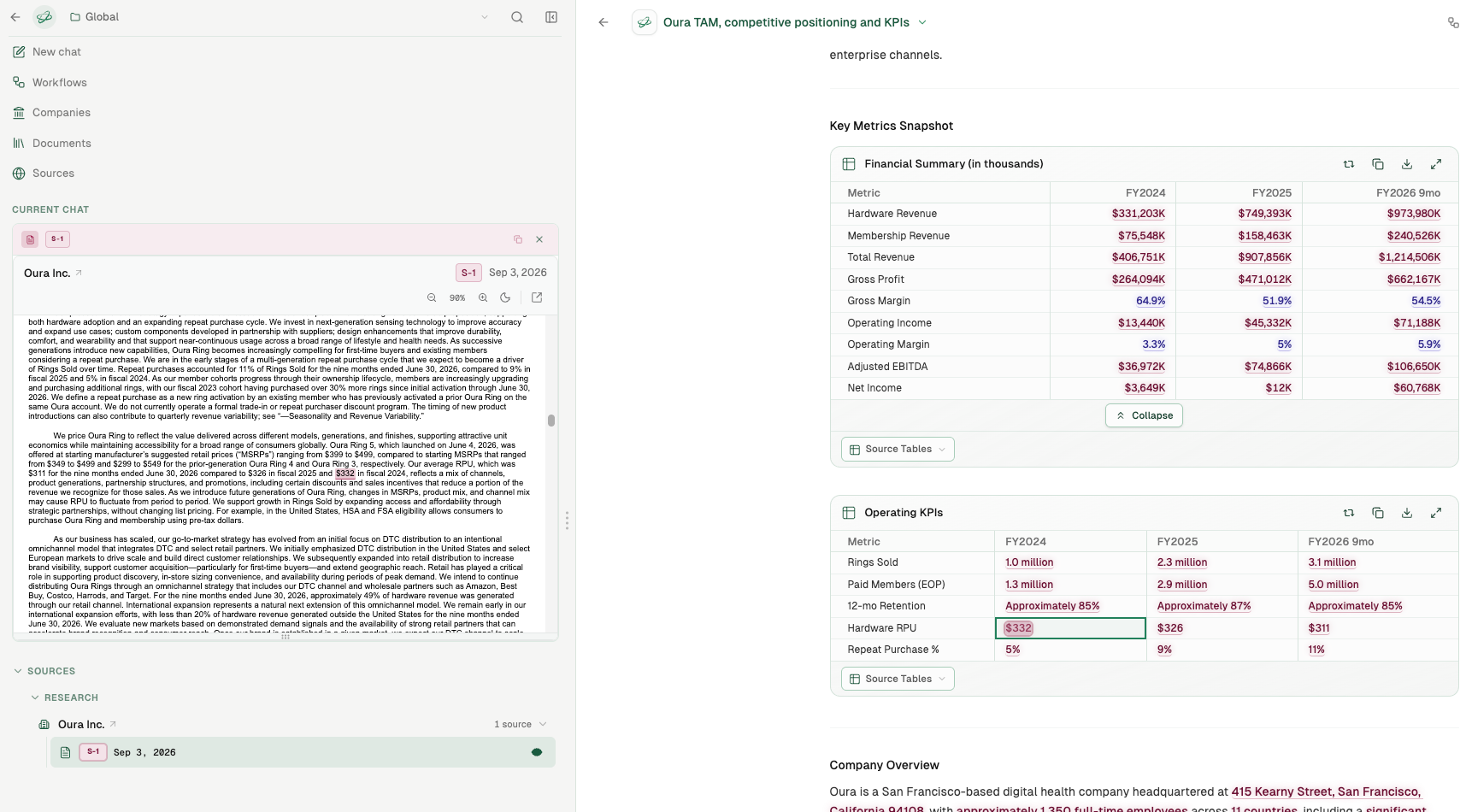
Financial summary (in thousands)
| Metric | FY2024 | FY2025 | FY2026 9mo |
|---|---|---|---|
| Hardware Revenue | $331,203 | $749,393 | $973,980 |
| Membership Revenue | $75,548 | $158,463 | $240,526 |
| Total Revenue | $406,751 | $907,856 | $1,214,506 |
| Gross Profit | $264,094 | $471,012 | $662,167 |
| Gross Margin | 64.9% | 51.9% | 54.5% |
| Operating Income | $13,440 | $45,332 | $71,188 |
| Operating Margin | 3.3% | 5.0% | 5.9% |
| Adjusted EBITDA | $36,972 | $74,866 | $106,650 |
| Net Income | $3,649 | $12 | $60,768 |
Operating KPIs
| Metric | FY2024 | FY2025 | FY2026 9mo |
|---|---|---|---|
| Rings Sold | 1.0 million | 2.3 million | 3.1 million |
| Paid Members (EOP) | 1.3 million | 2.9 million | 5.0 million |
| 12-mo Retention | ~85% | ~87% | ~85% |
| Hardware RPU | $332 | $326 | $311 |
| Repeat Purchase % | 5% | 9% | 11% |
Company overview
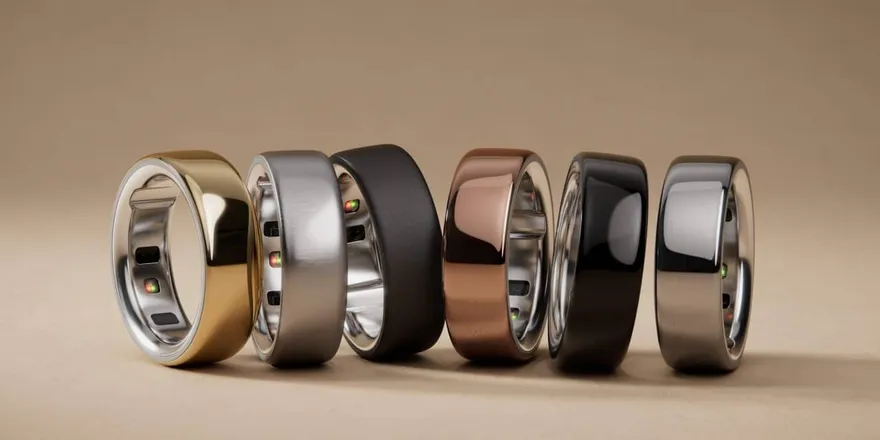
Oura is a Finnish digital health company, headquartered today at 415 Kearny Street, San Francisco, with approximately 1,350 full-time employees across 11 countries, including a significant portion in Finland where its hardware engineering roots remain. The company was built around the Oura Ring, a smart ring worn on the finger that continuously monitors heart rate, heart rate variability, blood oxygen, skin temperature, and movement. It earns revenue two ways: hardware sales and a recurring membership subscription.
The model is simple. A high-value hardware purchase (average revenue per unit of $311 in the nine months ended June 30, 2026) acts as both a revenue event and a customer acquisition mechanism, and approximately 94% of ring activations convert to paid memberships. Once someone becomes a member, engagement runs deep: median daily wear time of approximately 23 hours, a DAU/MAU ratio of approximately 65%, and members opening the Oura app more than 3.5 times per day. The app holds a 4.9 out of 5.0 rating on the Apple App Store, and twelve-month retention sits in the mid-to-high eighties across all cohorts.
Market opportunity
Oura sizes its serviceable addressable market at more than $90 billion using Statista data for 2026, spanning categories the company currently participates in or may enter. No formal CAGR is disclosed. At 3.6 million rings sold in the last twelve months against global wearable shipments of approximately 212 million units, Oura holds approximately 2% of the global wearable market: meaningful scale, and still barely penetrated.
The go-to-market story runs on two vectors. First, Oura takes share within the existing wearable installed base; approximately 29% of new members replaced a prior wearable device with the Oura Ring. Second, Oura pulls in consumers who have never worn a health wearable at all, with 33% of new members reporting Oura as their first wearable device. A third layer, barely monetized today, is the broader preventative health population. The company cites conditions affecting hundreds of millions globally (cardiovascular disease, sleep apnea, infertility, metabolic health) as the eventual long-term opportunity, though it attaches no dollar figure to this tier.
Competitive position and differentiation
Oura competes against three categories: large-cap smartwatch platforms (Apple, Google including Fitbit, and Samsung), fitness wearables (Coros, Garmin, and Whoop), and software-based health and wellness companies. Rivals bring more resources and broader portfolios. Oura’s defense rests on five structural advantages.
1. Sensing accuracy. The ring’s finger-based sensing delivers consistently high accuracy: approximately 99% for heart rate, 98% for heart rate variability, 96% for sleep, and 96% for ovulation tracking. The Oura Ring 5 is approximately 40% smaller than Ring 4. A portfolio of 1,140 patents and patent applications, including a core smart ring form factor patent validated by both ITC and PTAB, provides defensibility. The Samsung ITC complaint filed in December 2025 is an active litigation risk, and also a signal of how strategically important that IP has become.
2. Data asset. Oura has accumulated nearly 42 billion hours of longitudinal biometric data across its member base, a dataset that improves model accuracy, enables new features, and raises the bar for new entrants. More than 175 peer-reviewed publications have been built on Oura data, scientific credibility that opens healthcare partnerships and regulatory pathways.
3. Engagement flywheel. High wear time and daily app opens feed proprietary datasets, which improve AI models, which generate better health insights, which sustain engagement and retention. Twelve-month retention of approximately 85% and 5.0 million paid members (up from 2.5 million one year prior) suggest the flywheel is working. Oura also frames coexistence as the norm; members frequently use the ring alongside other platforms.
4. Ecosystem breadth. A network of more than 1,200 partners across 56 markets and approximately 8,400 retail doors gives Oura distribution density that took years to build. Partners contribute data back rather than merely consuming Oura’s output, which deepens the data asset over time.
5. Brand trajectory. US aided brand awareness grew from approximately 15% in Q1 FY2024 to approximately 38% in Q3 FY2026, and approximately 40% of new members arrive organically. Roughly 72% of members are women, and approximately 90% of members in the 2024 User Experience Survey reported improved overall health within the first month.
Growth strategy
Oura’s growth plan has five levers, each at a different stage of maturity.
Hardware cadence. A two-tier hardware strategy, premium flagship plus an accessible entry-level ring, broadens the addressable demographic while preserving technology leadership. New launches trigger concentrated marketing spend; the Ring 5 launch added $72.8M of paid media within sales and marketing during the nine-month period.
Membership pricing. The subscription price has been flat since 2021 while the feature set expanded materially. Management has flagged membership pricing as a long-term lever, a choice to prioritize adoption over near-term ARPU with pricing power held in reserve.
Enterprise and healthcare channels. Still early, but with the best acquisition economics of the lot. Partnerships with Cigna (employer wellness benefit) and Lumeris/Essence Healthcare (Medicare Advantage) amount to subsidized user acquisition where the employer or insurer, not the member, pays. A dedicated enterprise salesforce targets health insurers, employers, and government institutions.
Add-on products. Oura is layering services onto its subscriber base: blood panels (Quest Diagnostics), continuous glucose biosensors (Dexcom Stelo), and care services (Counsel Health / Medical AI). These are regulatory-gated and early-stage, but each adds monetization per member with limited marginal hardware cost.
International expansion. $237,829K of revenue came from outside the US in the nine months ended June 30, 2026, just 19.6% of the total, against a presence in 56 markets. International hardware revenue was less than 20% of hardware revenue. Management describes international as early-stage, building brand recognition through retail partnerships before scaling direct-to-consumer.
Financial analysis
Revenue and growth
Hardware grew 126.3% in FY2025 and 65.4% in the nine months ended June 30, 2026. Membership grew faster on both comparisons, 109.8% in FY2025 and 121% in FY2026, as the paid member base scaled faster than the device installed base. The revenue mix has been stable at roughly 80/20 hardware to membership: FY2024 was 81.4% / 18.6%; FY2026 nine months was 80.2% / 19.8%. As membership compounds on top of a maturing hardware base, the mix should shift toward higher-margin recurring revenue.
Quarterly revenue is seasonal. Q1 FY2026 (December 2025, the holiday quarter) was the strongest at $450,967K, falling to $354,815K in Q2 and recovering to $408,724K in Q3. Geography is concentrated: the US contributed 80.4% of revenue in the nine-month period, consistent with FY2025 (80.4%) and FY2024 (79.7%).
Margins
The gross margin story needs context. FY2024’s 64.9% compressed to 51.9% in FY2025 on Oura Ring 4 battery warranty reserves. As warranty costs normalized and per-unit manufacturing costs declined, gross margin recovered to 54.5% in the nine-month FY2026 period, with an encouraging intra-year path: Q1 FY2026 at 48%, Q2 at 57%, and Q3 at 60%. Management notes qualitatively that hardware gross profit offsets customer acquisition costs, though no segment-level gross margin is disclosed.
Operating margins are thin but expanding. Operating expenses fell from 62% of revenue in FY2024 to 47% in FY2025, then ticked back up to 49% in the nine-month FY2026 period on elevated G&A (a $48.3M increase driven by IP litigation and IPO readiness) and accelerated R&D headcount. The FY2026 components: S&M at 21% of revenue, R&D at 17%, and G&A at 10%. Operating income was $71,188K for the nine-month period, an operating margin of 5.9%. Adjusted EBITDA was $106,650K.
Cash flow and balance sheet
Oura converts operating income to cash well. Nine-month FY2026 operating cash flow was $328,008K against capex of $(66,240)K, with the capex step-up driven by office build-out and Ring 5 manufacturing capacity. FCF for the period was $261.8M, up from $122.5M in the same prior-year period. Cash on hand at June 30, 2026 was $371.8 million against $380.1 million of debt. The large cash outflow in the period reflects $(1,172,897)K of stock repurchases ($1,091.9M preferred, $79.5M common), a balance-sheet restructuring ahead of the IPO rather than a sign of operational stress. Management characterizes the company as less dependent on external equity.
Management team
Oura is led by Thomas Hale (CEO), formerly President of Momentive AI (SurveyMonkey) and COO of HomeAway, at the helm since March 2022. David Shuman serves as Executive Chairman, with Goldman Sachs investment banking roots and over a decade in public equity investing through his Lateralus Holdings vehicle. Sean Brecker (CFO) joined in October 2023 from Headspace, where he served as both CEO and CFO, and has capital markets experience across Citi, Nomura, and Lehman Brothers. Michael Chapp (COO) has run operations since April 2019 and served as interim CEO during the 2021–22 leadership transition.
The board adds operating depth. Nominees joining post-IPO include Leslie Kilgore (CMO of Netflix 2000–2012; current Netflix and Pinterest board member), Jason Warnick (CFO of Robinhood Markets; 20 years at Amazon before that), and David Sze (Greylock Partners; early investor in LinkedIn and Facebook). Existing directors include Dennis Durkin (former CFO/President of Activision Blizzard; current Roblox and On Holding director), Eurie Kim (Managing Partner, Forerunner Ventures), and Timo Ahopelto (Founding Partner, Lifeline Ventures; Nokia board member).
Shareholder base
Pre-IPO ownership information is disclosed by name, but share counts and percentages will be populated at pricing. Key institutional holders: FMR LLC (Fidelity) is the largest disclosed financial investor, having deployed approximately $125.0 million in the Series D in December 2024 and approximately $629.6 million in the Series E in September 2025. Lifeline Ventures (Finland) is an early VC holder. Forerunner Ventures is also a holder, and had a portion of its Series B position repurchased in a $65.0 million buyback in February 2026. Matter Venture Partners (affiliated with director Wen Hsieh) holds a stake. Executive Chairman David Shuman holds an indirect carried interest in Bedford Ridge Investment Company through a family trust.
Key risks
Samsung patent litigation. Samsung, a direct competitor, filed an ITC complaint in December 2025 targeting Oura’s ring form factor. An adverse ruling could disrupt product imports into the US. Oura’s core ring form factor patent has been validated by ITC and PTAB in prior proceedings, but litigation risk remains material.
Subscription model risk. Emerging lower-cost smart rings without subscription fees represent a pricing model threat. Oura’s value proposition depends on sustained membership conversion and retention; a market shift toward subscription-free alternatives could impair economics.
Gross margin volatility. The FY2025 warranty-driven compression, from 64.9% in FY2024 to 51.9%, shows how fast hardware problems reach the margin line. New product launches, manufacturing defects, or supply chain disruptions can materially impair margins with limited lead time.
Geographic concentration. 80.4% of revenue is US-sourced. International expansion is early-stage and carries execution risk around localization, regulatory approval (FDA and international equivalents), and retail partnership build-out.
No disclosed targets. Oura provides no explicit revenue growth, gross margin, operating margin, or EBITDA targets, which limits visibility into management’s own expectations and complicates model calibration for investors.
Large-cap competitive resources. Apple, Google/Samsung, and Garmin command substantial resources and diversified portfolios, and could accelerate investment into health-intelligence features on existing wearable platforms, narrowing Oura’s differentiation over time.
Source: Oura Inc. S-1 Registration Statement filed September 3, 2026. All financial data as disclosed therein. This note is for informational purposes and constitutes summary analysis of publicly filed documents.